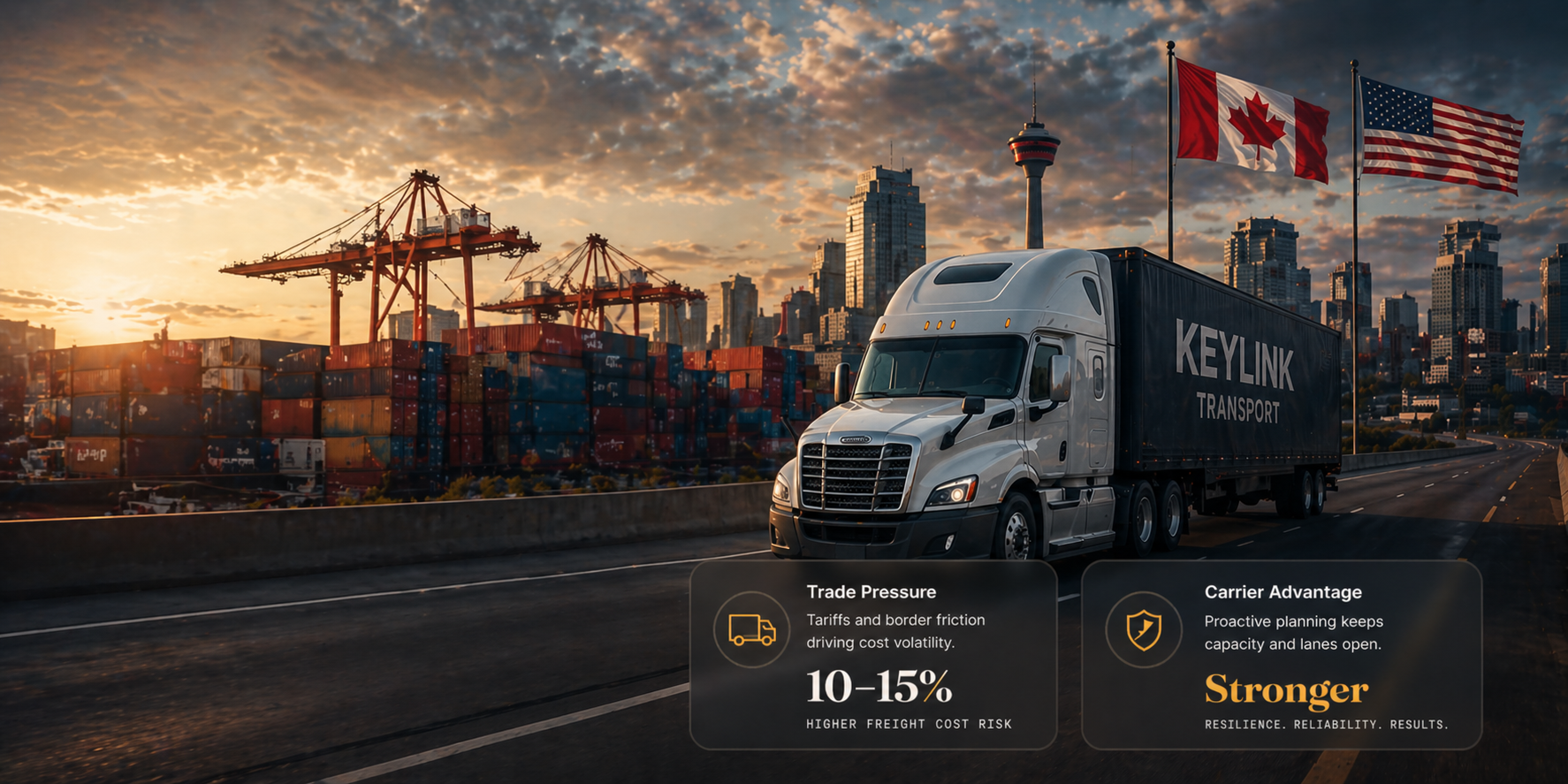
For nearly three years, the North American trucking industry has been slogging through the longest and deepest freight recession in modern memory. Spot rates that peaked in mid-2022 collapsed through 2023 and stayed low through all of 2024. Small carriers exited the business in record numbers. Operating ratios blew past 100% for most of the industry. And shippers got used to calling the shots on price.
That era is ending. Q2 2025 data across multiple independent sources — DAT's van linehaul index, FreightWaves SONAR, Freightos's BLI, and Statistics Canada's commercial transport data — all show the same pattern: spot rates firming, tender rejection rates climbing, capacity tightening, and contract renegotiations moving in carriers' favor for the first time since early 2022. FreightWaves' mid-year analysis called Q2 2025 "the inflection quarter" for North American truckload. In Canada, the picture is similar but with tariff-driven wrinkles that make the local market distinctly its own story.
This article walks through the data, explains why the turn is happening now, and gives Canadian shippers a practical framework for responding to a rate environment that is about to stop being permanently friendly.
A Quick Recap of the 2022-2024 Freight Recession
The post-pandemic freight boom peaked in mid-2022. Spot van rates on US lanes had hit all-time highs of roughly $3.15/mile all-in in May 2022. From there, it was downhill. By Q1 2024, DAT's national van spot rate had dropped to approximately $2.10/mile all-in, a decline of roughly 33% in under two years. Canadian spot rates followed a similar trajectory with some lag.
The causes were straightforward: a massive capacity expansion during the 2021-2022 boom, consumer demand that softened as pandemic savings ran out, e-commerce growth rates that normalized, and an industrial recession in goods-producing sectors. The result was a classic oversupply problem. Too many trucks chased too few loads, and spot rates collapsed toward cash operating cost for the marginal carrier.
The adjustment process took longer than most industry observers expected. The capacity that entered during the boom was slow to leave because many new owner-operators had equipment financed at favorable rates and operating costs below market rates. It took until mid-2024 for the carrier exit rate to accelerate meaningfully, and even then, industry analysts at Transport Topics continued to warn that supply-demand rebalance would take until at least mid-2025.
What the Q2 2025 Data Actually Shows
The Q2 2025 numbers confirm what carriers have been feeling on the lanes for several months. Specifically:
- Spot rates up 12-15% year-over-year. DAT's van linehaul spot rate averaged approximately $2.38/mile in June 2025, up from $2.08/mile in June 2024. That is the strongest Q2 reading since 2022.
- Tender rejection rates above 8%. FreightWaves SONAR's Outbound Tender Rejection Index has climbed from sub-3% in Q1 2024 to 8-9% in June 2025. Tender rejections above 7% signal a tight capacity market.
- Contract rates following spot. Contract rate growth has finally turned positive after 14 months of decline. Shippers negotiating renewals in Q2 2025 are seeing increases of 4-8% on most lanes, with tariff-affected cross-border lanes seeing more.
- Carrier revenue per truck up. Publicly traded carriers like Knight-Swift, Werner, and Heartland all reported Q1 2025 earnings with improving revenue per truck and tighter capacity guidance for Q2 and Q3.
- Driver wages firming. The American Trucking Associations' driver wage index rose 3.2% year-over-year in May 2025, the strongest growth since 2022.
Carrier Attrition Finally Catches Up to Demand
The single biggest structural driver of the rate recovery is capacity attrition. FMCSA data shows that US for-hire carrier authority counts declined by approximately 45,000 over 2023 and 2024 combined, and that exit rate has continued into H1 2025. In Canada, Canadian Trucking Alliance research shows similar patterns: small carrier exits, owner-operator retirements, and consolidation among mid-sized carriers all reduced Canadian for-hire capacity by an estimated 8-12% over 2023 and 2024.
When capacity exits and demand recovers even modestly, the supply-demand equation flips. That is exactly what Q2 2025 is showing. Demand has not roared back to 2022 levels, and probably will not. But demand has stabilized, and the supply side has been grinding down for long enough that the balance has tipped.
"We are not looking at a 2021-style boom. We are looking at a normalized market where carriers can cover their operating costs plus a modest margin. For an industry that has spent three years below cash break-even on many lanes, 'normal' is a big change."
The Tariff-Driven Rebalance
The March 4 IEEPA tariffs and April 2 Liberation Day reciprocal tariffs have added a separate supply-demand dimension on top of the normal cycle. Cross-border volume has shifted significantly as shippers pre-position inventory, rearrange supply chains, and adjust to the tariff environment. Three specific patterns are visible in the Q2 data:
- Domestic US demand up, cross-border demand down: US-to-US lanes are benefiting from reshoring effects and reduced import volume. Canada-to-US auto lanes are down. BC-to-US West Coast lanes are holding stable because of consumer goods composition.
- Capacity repositioning: Carriers that had been heavy in cross-border auto parts are moving trucks into US domestic lanes. This is temporarily easing domestic capacity but also reducing the cross-border capacity available for shippers whose cross-border lanes are still active.
- Port drayage volatility: The Pacific Northwest ports (Seattle, Tacoma, Vancouver BC) and East Coast ports are seeing import surges ahead of feared further tariff increases. Drayage and port-outbound capacity is tight.
Spot vs Contract: Why Contracts Are Now the Story
During the freight recession, the spot market was where the action was. Shippers could get almost any lane covered on spot at rates below the contract market, and many shippers quietly let contract percentages slide as they chased short-term savings. In Q2 2025, that dynamic has flipped. Spot capacity is tighter, spot rates are climbing, and tender rejection rates indicate that contracted carriers are increasingly rejecting low-priced tenders in favor of higher-paying spot loads.
For shippers, this means the contracted relationship is back to being the primary risk management tool. Carriers with strong contract books can provide committed capacity at predictable rates. Shippers relying on the spot market for primary freight movement are exposing themselves to rate volatility and capacity scarcity that they have not had to worry about for three years.
The contract renewal conversations happening in Q2 2025 are fundamentally different from the conversations of 2023 and 2024. Carriers are bringing data: tender rejection rates, cost structure increases, insurance premium inflation, driver wage pressure. Shippers who walk into those conversations with a "we want a 3% decrease" mindset are going to find themselves losing carriers and paying spot rates for primary lanes.
Why the Canadian Recovery Looks Different
The Canadian recovery has some specific wrinkles that differ from the US picture. First, the Canadian carrier exit rate through 2024 was proportionally more severe than the US exit rate. The Statistics Canada transportation data shows for-hire trucking industry GDP declined approximately 6% year-over-year in 2024, the worst performance since the 2008-2009 recession. That sharper exit creates a tighter capacity base for the 2025 recovery to bounce off.
Second, cross-border tariff disruption is creating opportunities for Canadian domestic carriers that US carriers do not face. As Canadian exporters shift some production back to domestic customers, Canadian-only lanes are seeing volume growth that US-only lanes are not. Third, the BC and Prairie corridors are performing noticeably better than the Ontario-Quebec corridor because of differing tariff exposure on the product mix.
For Canadian shippers, the practical implication is that rate recovery will be patchy. BC lanes and Prairie lanes will see measured recovery. Ontario-Quebec lanes tied to manufacturing and auto sectors will see mixed results, with tariff-affected sectors facing softer volume but tight capacity simultaneously. Cross-border capacity for CUSMA-compliant goods is tightening as the carrier base shifts back to US-dominant lanes.
What Shippers Should Be Doing Now
If you are a Canadian shipper, here is a practical playbook for the rate environment you are actually in:
- Renegotiate contracts early where you can. If your primary lane contracts are expiring in Q4 2025 or Q1 2026, bring them forward. Locking in 2025 rates on current capacity is cheaper than negotiating in a tighter 2026 market.
- Shift from spot to contract on primary lanes. If you have been running primary freight on spot because it was cheaper, move those lanes into contracts before spot rates tighten further.
- Qualify backup capacity now. The carriers who will be available to cover your freight in Q4 2025 are the ones you establish relationships with in Q2 and Q3. Waiting until you need them is too late.
- Invest in the carrier relationship. Carriers are tired of being treated as interchangeable commodities. Shippers who demonstrate fair treatment, prompt payment, efficient loading, and predictable volume will get preferred capacity when capacity gets scarce.
- Model tariff exposure explicitly. Your freight rates are not the only thing moving. Build scenarios where tariffs escalate, stabilize, or roll back, and understand how your total landed cost shifts under each.
Keylink Transport has been running BC-to-US lanes through the freight recession and into the recovery. Our capacity is being reserved for long-term partners as the market firms. Talk to our team about Q3 and Q4 2025 commitments.
Reserve Capacity →The Bottom Line
The great freight recession is ending. Not with a dramatic boom, but with a slow rebalance as carriers exit, demand stabilizes, and the supply-demand curve finally flips. Q2 2025 data across every major source confirms the turn. Spot rates are up. Contract rates are following. Capacity is tightening. Carriers are regaining pricing power for the first time since early 2022.
For Canadian shippers, this is the transition window. The next 90 to 180 days are when carrier relationships, contract structures, and capacity commitments that will define your freight cost structure for 2026 are being locked in. The shippers who engage proactively, invest in their carrier relationships, and lock in capacity will carry a structural advantage into 2026. The shippers who assume the recession rates will continue indefinitely will spend 2026 reacting to a market that has moved on without them.