- May 4: A Missile Strike Near Dubai Lights Up Oil Markets
- What Diesel Looks Like at the Canadian Pump Today
- Why This Spike Is Different from Past Oil Shocks
- The Federal Fuel Excise Tax Cut: Welcome but Not Enough
- The Small-Carrier Squeeze: A Final Nail for Many
- Where the Oil Spike Actually Bites a Canadian Carrier
- How Keylink Is Holding the Line for Our Customers
- What Canadian Shippers Should Be Doing Right Now
- The Bottom Line
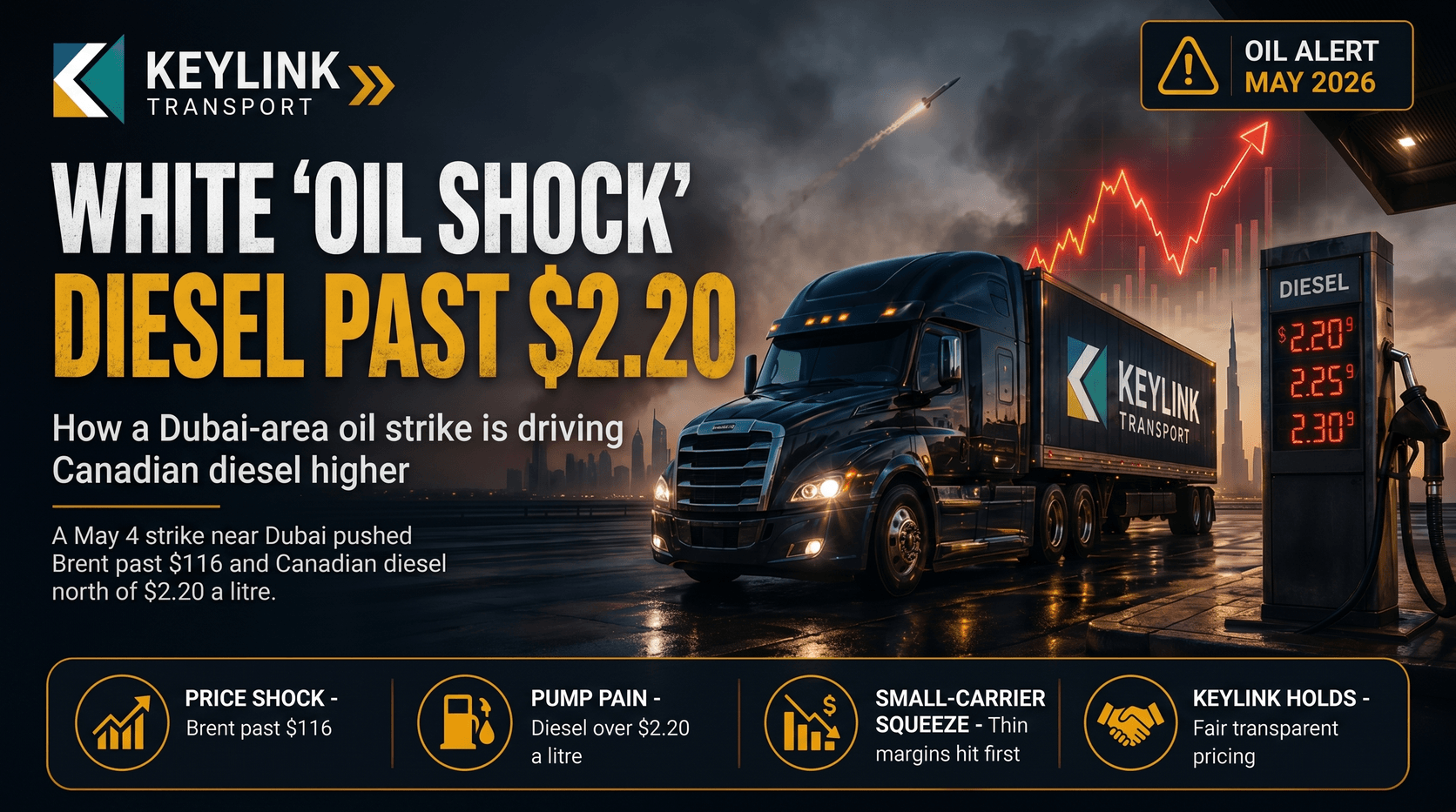
The most consequential oil event of 2026 happened this morning, just a few hundred kilometres from Dubai. A drone and missile barrage struck a petroleum facility in the United Arab Emirates, lighting commodity desks up from Calgary to Singapore and sending Brent crude through $116 a barrel. By the time most Canadian dispatchers had finished their morning coffee, diesel benchmarks were already moving. By the end of the week, every fuel surcharge in the country will reflect what happened today.
This post is what we are seeing on the road as the Dubai-area strike feeds into Canadian diesel prices, what the news is telling us about how we got here, and what Keylink Transport is doing to protect the customers we move freight for through one of the most punishing fuel environments in years.
May 4: A Missile Strike Near Dubai Lights Up Oil Markets
Earlier today, the United Arab Emirates confirmed that its forces were responding to an Iranian drone and missile attack, with authorities in Fujairah, on the UAE coast east of Dubai, reporting a fire at an oil facility. According to Al Jazeera's live coverage, Iranian state media also claimed two missiles struck a US Navy frigate in the Strait of Hormuz after it disregarded warnings from Iran's navy. The US military denied any vessel was hit. The strikes came in response to Trump's recently announced "Project Freedom," a US-led operation to free stranded ships caught in the Hormuz chokepoint.
Fujairah matters in the global oil picture for a reason most people outside the energy market do not realize: it is one of the largest bunkering and petroleum storage hubs in the world, sitting just outside the Strait of Hormuz. An attack on its facilities is not symbolic. It hits real volume, real storage, and real shipping schedules, and it does so within an hour's drive of Dubai, the financial capital of the Gulf. Markets price that geography immediately.
Markets reacted predictably. Fortune reported that oil opened the month at $116.10 per barrel on May 1. Brent benchmarks are now expected to trade between $115 and $135 through May, and WTI in the $105 to $125 range, as the supply disruption from the Hormuz situation, OPEC+ politics and refining bottlenecks redefines pricing.
Just a day before the Dubai-area strike, on May 3, OPEC+ announced a 188,000 barrel-per-day output increase for June, in its first meeting without the United Arab Emirates at the table. The increase is symbolic. It is nowhere near enough to backfill the volume now bypassing the Strait of Hormuz, and the political signal of a fractured cartel is itself a price-supportive event. The next OPEC+ meeting is going to be a very different conversation after today.
What Diesel Looks Like at the Canadian Pump Today
According to GlobalPetrolPrices, the average diesel price in Canada was CAD $2.11 per litre as of late April. Haulalytics' provincial diesel tracker shows wide variance, with British Columbia and parts of Atlantic Canada already pushing well above the national average. Natural Resources Canada's weekly diesel benchmarks are the same data the freight industry uses to set fuel surcharges, and those numbers have ratcheted up nearly every week of 2026.
Small Canadian truckers, who are most exposed to spot diesel pricing, are reporting per-litre costs north of $2.20. Canada's National Observer reported on April 1 that diesel had jumped roughly 75 per cent from $1.25 a litre before the most recent US-Israel attacks on Iran. BNN Bloomberg followed on April 10 with analysis that diesel will remain elevated for months and is likely to hit consumers harder than gasoline as transportation cost pressure passes through the supply chain.
Why This Spike Is Different from Past Oil Shocks
Canadian carriers have lived through diesel spikes before. The 2022 surge after Russia invaded Ukraine sent benchmark crude past $120. The 12-day Iran-Israel war in June 2025 took diesel up another 20% before easing. What makes the current shock harder to absorb is not just the price level. It is the duration and the structural cause.
The US Energy Information Administration's Short-Term Energy Outlook now projects Brent to peak in Q2 2026 around $115 a barrel before easing later in the year as production shut-ins slowly recover. Translation: refineries are not running at the volumes that would normally cap a price spike, and supply will not be normal until well into the second half of the year. Canadian shippers and carriers should be planning their freight budgets for elevated diesel through Q3 at minimum.
On the demand side, C.H. Robinson's March 2026 freight market update noted that the national average diesel price had risen nearly every week of 2026 well before the May 4 Fujairah event, driven by the ongoing Strait of Hormuz crisis and tightened North American refining capacity. The supply backdrop was already fragile. The Fujairah attack is gasoline on the fire, not the fire itself.
The Federal Fuel Excise Tax Cut: Welcome but Not Enough
Ottawa is not blind to the pressure. On April 17, the Carney government announced a temporary suspension of the federal fuel excise tax on gasoline and diesel from April 20 through September 7, 2026. The cut works out to roughly four cents a litre on diesel, with Land Line Media reporting Prime Minister Carney framing it as relief at the pump while the broader trade and energy fight continues.
The Canadian Trucking Alliance welcomed the move, with president Stephen Laskowski telling reporters that "stability in fuel prices is a key tool in the fight against inflation and keeping costs down." That is a polite endorsement, not a celebration. Four cents a litre on a fuel bill that has risen by 75 cents over four months covers about five per cent of the increase. For a Class 8 fleet refuelling 200 litres at a time, the relief is roughly $8 per fill against a tank that now costs $700 more than it did at the start of the year.
"Please help. We can't keep absorbing this. We need help right now or we're going to start passing it on, and that means food, that means everything." - Canadian small-fleet operator quoted in CTV News, April 2026.
The Small-Carrier Squeeze: A Final Nail for Many
The fleets feeling this most acutely are the small ones. National Observer's reporting notes that small and midsize carriers represent two-thirds of Canada's roughly 135,000 trucking businesses. Fuel historically accounts for 25 to 35 per cent of operating costs for these operators. With diesel at current levels, that share is now closer to 45 or 50 per cent. One four-truck operator in the Toronto area told the Observer their per-truck fuel bill jumped from $1,600 to $2,300 a fill.
Industry voices have been blunt. CTV News reported Canadian truckers warning that rising diesel costs will drive up food and goods prices, with carriers describing the diesel curve as a "please help" moment. A Newswire industry release framed it as a double crisis: a prolonged freight slowdown that has only just begun firming, now compounded by a fuel cost crisis that arrived before margins had a chance to recover.
For shippers, that exit pressure matters. Capacity that disappears now will not magically reappear when the geopolitical picture clears. The carriers that go under in May 2026 leave a gap that gets filled, eventually, by stronger fleets at higher prices.
Where the Oil Spike Actually Bites a Canadian Carrier
Most coverage of the diesel spike fixates on the price at the pump. For an operating Canadian fleet, the cost shows up in five distinct places.
1. Fuel Cost on Every Mile
A Class 8 tractor pulling a loaded trailer averages between 35 and 45 litres of diesel per 100 km. At $2.20 a litre, a Vancouver to Calgary run that used to cost $1,400 in fuel now costs roughly $2,400. That is real money against thin operating margins.
2. Surcharge Lag
Most carriers price fuel surcharges off the previous week's diesel benchmarks. When prices rise quickly, carriers absorb the spread between what they paid at the pump this week and what they billed a customer based on last week's index. Multi-week price runs compound that lag.
3. Insurance and Equipment Inflation
Higher fuel costs push up the cost of every input the trucking industry depends on, from tires to truck parts to repair labour. Insurance premiums also reset higher when carriers report higher operating costs.
4. Cash Flow Strain
Fuel cards bill weekly. Customer invoices sit in 30 to 60 day terms. The longer the gap between paying for diesel and being paid for the load, the more working capital each truck consumes. For small fleets, this is the failure point.
5. Customer Volatility
Shippers are slower to commit to long contracts when fuel surcharges are moving every week. That pushes carriers toward spot exposure, which in a tight diesel environment is the worst place to be.
How Keylink Is Holding the Line for Our Customers
Keylink Transport is BC-based, with our home in Abbotsford and our work running the BC corridor and pushing south of the border. We are a full truckload carrier, not a fuel-hedging desk, but the way we run our operation through this kind of fuel environment is one of the most important services we offer our customers. Here is what that looks like in practice.
Index-Linked Fuel Surcharges, Updated Weekly
Our surcharge structure tracks Natural Resources Canada's weekly diesel benchmarks. When diesel moves, the surcharge moves with it, in both directions. Our customers see exactly what they are paying and why, and there is no hidden margin in the fuel line.
Lane Density on the BC and Cross-Border Corridors
Empty miles are the most expensive miles you can run at $2.20 diesel. We have concentrated dispatch on building paired loads on the Lower Mainland to Calgary lane and our cross-border runs, so trailers move loaded in both directions. That brings the effective per-load cost down even when fuel is rising.
Driver Coaching on Fuel-Efficient Driving
Speed kills fuel economy. Our drivers run governed cruise, idle reduction, and progressive shifting standards that pull two to four per cent fuel improvement out of every truck. That is not theoretical. It is verifiable on every weekly fuel report and we share the gains with the customer through more stable rates.
Honest Pricing, No Stealth Increases
When fuel jumps, we get on the phone before our customers have to ask. They learn what the surcharge is doing for the next billing cycle, and what we are doing on our side to absorb what we can. No surprise invoice spikes.
Equipment Reliability That Protects Margins
A breakdown costs more than the tow. It costs the deadhead recovery miles, the missed appointment, the spot-rate replacement load. Our preventive maintenance program is what keeps our fleet on the road in a market where every load has to count.
Driver Stability Through the Squeeze
Carriers are exiting. Drivers are watching. We are doubling down on the things that keep drivers in the seat at Keylink: predictable home time, clean equipment, and dispatch that respects the work. A stable driver roster is the single biggest reliability advantage we can give a Canadian shipper through a fuel crisis.
Diesel is not coming back to $1.50 this quarter. The carriers that survive the rest of 2026 will be the ones that price fairly, run lean, and pick up the phone. That is what Keylink does, every load, every week.
Talk to Our Team →What Canadian Shippers Should Be Doing Right Now
Whether you ship out of the Lower Mainland, Calgary, the Prairies, or anywhere on the cross-border lanes, the next 60 to 90 days are the most important window of the year for getting your freight strategy lined up against the diesel reality.
Audit Every Fixed Surcharge Table
Pull every active carrier contract this week. Identify any that use fixed surcharge brackets or stale escalators. Renegotiate to weekly index-linked formulas that track NRCan benchmarks. Fixed tables are losing carriers money on every load right now and that loss eventually finds your invoice.
Consolidate Around Reliable Carriers
Spreading volume across ten thinly-committed carriers worked when capacity was loose and diesel was cheap. Today, two or three deeper carrier partnerships will get you better service, more rate stability, and a phone that actually picks up when the diesel index lurches.
Build a Price-Pass-Through Plan With Your Customers
Whatever industry you are in, if your inputs depend on trucked freight, the diesel curve will eventually arrive in your COGS. Have the conversation with your downstream customers now, not when the next invoice lands.
Front-Load Inventory Where You Can
If you have storage capacity and a stable demand forecast, pulling inventory forward through May and June can lock in lower freight cost-per-unit before any further escalation. The math on holding cost is currently favourable against the trajectory of diesel.
Use a Carrier That Will Tell You the Truth
The worst position a Canadian shipper can be in right now is finding out about a fuel surcharge change, capacity tightening, or border issue from an invoice. A carrier that proactively flags risk is worth ten cents a mile more than one that quietly absorbs the cost until they cannot.
The Bottom Line
Today's missile strike on the UAE coast east of Dubai is the latest reminder that the price of diesel at a pump in Surrey or Edmonton is being decided by events thousands of kilometres away. Brent at $116, Hormuz under threat, OPEC+ fragmenting, refining capacity short, and a federal fuel excise cut that helps at the margins but does not change the trajectory. This is the operating environment Canadian trucking has to work through for the rest of the spring and into the summer.
The carriers that come through this in good shape will be the ones that priced fuel honestly from the start, ran tight lanes, kept their drivers, and treated their customers like partners rather than line items. Keylink Transport has been a corridor carrier on the BC and cross-border lanes for years. We have run through the 2022 spike, the 2025 Iran-Israel shock, and now this. The playbook does not change. Honest pricing. Lean operations. Real communication. Reliable equipment. Drivers who want to be in our trucks.
The trucks have to keep moving. We will make sure ours do, and we will make sure our customers know exactly what they are paying for and why, every week, every load, until this market settles.