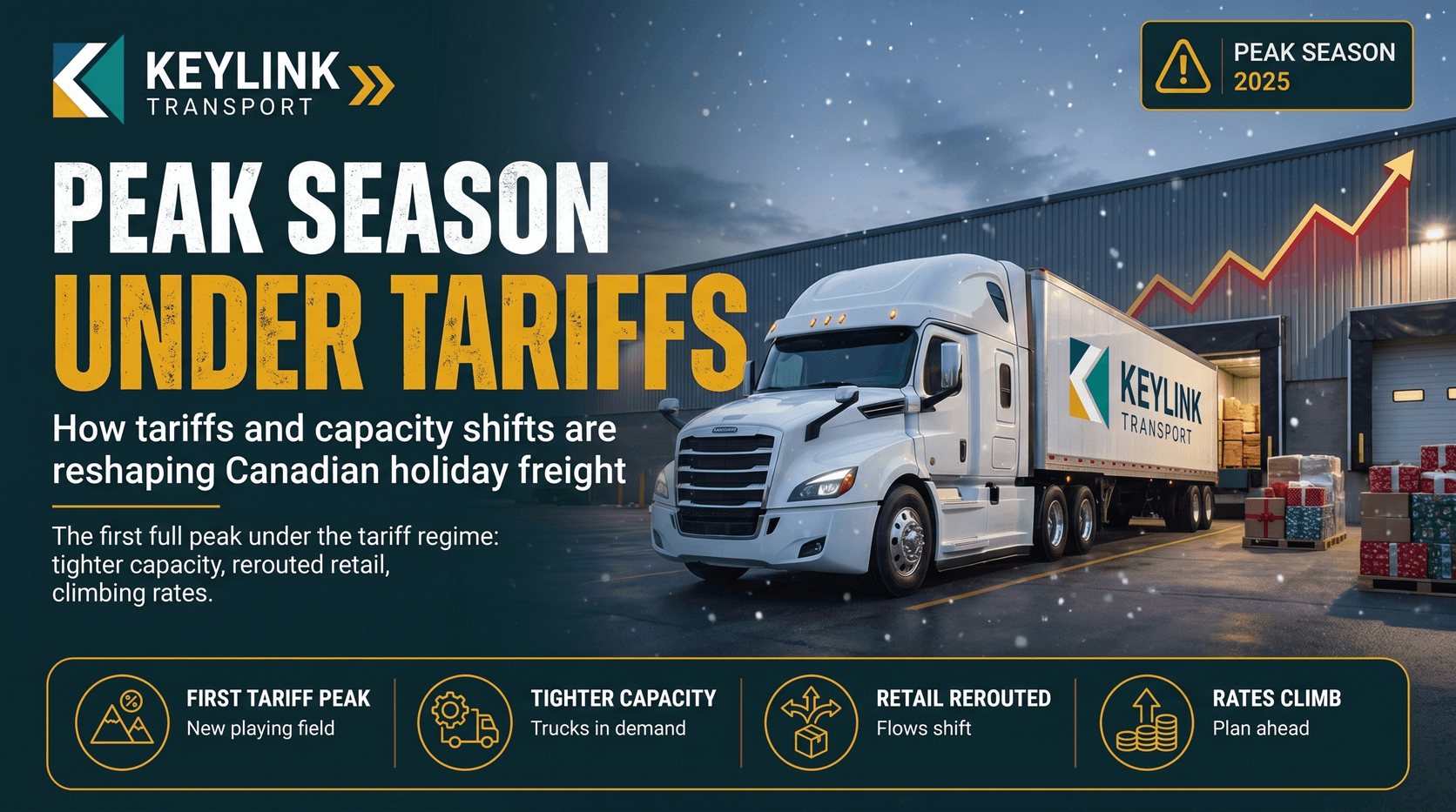
Retail peak season is officially underway. Halloween inventory has cleared the shelves, Black Friday ads are being finalized, and the industry's busiest eight weeks have begun. For Canadian freight, peak 2025 is fundamentally different from the peaks of the recent past. It is the first full peak season operating under the Trump tariff regime, the first peak since capacity stopped being in persistent oversupply, and the first peak where retailers are openly publishing tariff-related price adjustments to consumers.
The result is a peak season that looks tight where prior peaks have looked loose. Spot rates on cross-border consumer goods lanes are climbing. Distribution center operations are running at higher inventory levels because retailers pre-built inventory in Q2 and Q3 to hedge tariff risk. Border wait times are elevated but stable. Capacity is tight but manageable. And prices are moving.
This article walks through where the Canadian freight market actually sits in early November, what carriers and shippers should expect through December and early January, and the specific playbook that the best Canadian shippers are running through this peak.
Peak 2025 in Context
To set the stage: retail peak in a normal year runs approximately from mid-October through mid-January. Black Friday and Cyber Monday volume concentrates in the last week of November and first week of December. Holiday direct-to-consumer fulfillment peaks in the second and third weeks of December. The post-Christmas returns wave runs from December 26 through mid-January. Total freight volume during this window is typically 25 to 35% above trailing annual averages.
Peak 2024 was unusual: soft consumer demand kept rates depressed even during the seasonal surge, and carriers reported peak volumes that landed only 10 to 15% above off-season baselines. Peak 2023 was similar. Peak 2022 was the last "hot peak" where capacity genuinely tightened and spot rates surged. Peak 2025 looks closer to 2022 than to 2024 or 2023, but with tariff-driven structural changes that no prior peak has seen. The US National Retail Federation's 2025 holiday forecast projects holiday sales growth of 3.5 to 4.5% year-over-year, with significant variance by category based on tariff exposure.
What Is Different About This Peak
Pre-Built Inventory
Canadian and US retailers spent Q2 and Q3 2025 pre-building inventory to hedge against further tariff escalation. The result is that distribution centers across Ontario, BC, and the US Northeast are sitting on elevated inventory levels going into November. This reduces the acute Q4 inbound freight surge that typically drives peak rates, but it also means DC operations are running at higher complexity and throughput requirements than usual.
Tariff-Driven Price Tags
Retailers are openly attaching tariff-related price increases to specific SKUs. The political environment has made this acceptable commercial practice in a way it was not during Trump's first term. Walmart, Target, and Best Buy have all publicly announced tariff-related pricing on specific product categories. CNBC's October coverage of retailer pricing strategy captures how the industry has normalized tariff surcharges in consumer-facing pricing. The freight implication is that volume on high-tariff categories (electronics from Vietnam and China, furniture, apparel) is down relative to prior years.
Shifted Import Patterns
The tariff structure has materially shifted where imports land in North America. The Port of Los Angeles and Long Beach have been running below historical peaks because Asian import volume is down. The Port of Vancouver, Port of Prince Rupert, and Canadian East Coast ports are picking up some of the diverted volume. This shifts freight flows from traditional US-centric trucking corridors onto Canadian corridors, and it concentrates drayage and inland trucking capacity in ports that have not historically handled this volume.
How Retail Flows Are Rerouted
BC and Canadian West Coast Growth
Container volume through Vancouver and Prince Rupert is running roughly 8 to 12% above 2024 levels year-to-date. For BC-based carriers, this has meant meaningful volume growth on Port-to-Lower-Mainland drayage and on BC-to-Alberta and BC-to-Prairie intermodal lanes. Warehousing capacity in Richmond, Delta, and Surrey has been filled earlier than usual, and some distribution operators have begun looking at overflow capacity in Chilliwack and Abbotsford.
Cross-Border Retail
Canadian retailers sourcing US-origin goods are still running normal import volumes since the US-to-Canada flow is not subject to the Trump tariffs (only Canadian retaliatory tariffs on specific categories apply). US retailers selling into Canada continue to ship normally. The friction point is cross-border B2B flow for Canadian-made goods destined for US consumers, where CUSMA compliance remains the critical paperwork gate.
Direct-to-Consumer Parcel Surge
The parcel side of peak is running hot. Amazon, Shopify merchants, and direct brand D2C operations are pulling forward order capacity commitments. Parcel carrier capacity (Canada Post, Purolator, UPS, FedEx, intelcom, and smaller regional parcel providers) is running tight. For shippers that use a mix of LTL and parcel, capacity constraints on the parcel side are pushing some volume into LTL, which in turn is tightening LTL capacity. FTL markets are less directly affected but indirectly feel the tightening.
The Capacity Picture Going into December
Van and reefer capacity is tight but not stressed. The supply-demand rebalance that started in Q2 has matured into genuine capacity tightness during peak. Tender rejection rates in the FreightWaves SONAR index have sat above 10% since mid-October, a level not seen in peak seasons since 2021. Carriers with strong contract books are running near full utilization. Spot capacity is available but priced materially above contract rates.
The specific capacity pinch points for November and December:
- BC Lower Mainland: Port volume growth plus Lower Mainland retail distribution volume is tight. Spot rates on Metro Vancouver to Alberta are running 8 to 12% above October levels.
- Southern Ontario: Auto sector softness has freed up some cross-border capacity, but domestic retail movement within Ontario and to Quebec is tight. Contract carriers are protecting core customers and spot market shippers face higher rates and service variability.
- US Northeast: Port of New York/NJ volume is strong. Drayage capacity is tight. Inbound Canadian cross-border freight to the Northeast is seeing normal lane pricing but longer appointment windows at receivers.
- Midwest: Retail DC outbound volume is strong. E-commerce fulfillment centers in Ohio, Indiana, and Pennsylvania are running at elevated volumes. Regional carriers are stretched but holding.
"Peak 2025 is not a crisis. It is a genuinely tight capacity market running through a busy season. Shippers who have their capacity committed will get their freight moved. Shippers who do not will pay spot rates and accept whatever transit times the market offers."
Rate Outlook for November and December
DAT, FreightWaves, and Freightos all project continued rate strength through December. The consensus forecast is:
- Spot van rates: +3 to +5% from early November levels through mid-December, softening in the last two weeks of December as pre-Christmas demand subsides.
- Spot reefer rates: +5 to +8% through November (driven by holiday fresh and frozen food), moderating in December.
- Contract rates: Stable through year-end, with 2026 renewal negotiations trending 5 to 8% above 2025 contract levels for lanes with significant tariff exposure, and 3 to 5% above for unaffected lanes.
- Cross-border surcharges: Many carriers have instituted explicit tariff-management surcharges on affected lanes. Shippers should model total landed cost including these surcharges, not just the base linehaul rate.
Consumer Goods Freight Specifically
For shippers moving consumer goods through peak, the practical mechanics matter more than the macro outlook. A few specific observations from the first two weeks of November:
Pickup appointment availability: Loading dock capacity at major shippers is booked out 3 to 5 business days. Rush pickups are still possible but command premium pricing.
Receiver appointment availability: Major retail DCs are running tight appointment windows. Carriers who miss appointments by more than 2 hours face rescheduling that can push delivery into the following business day. This compounds through the supply chain and is the single biggest service failure risk during peak.
Returns logistics: Post-Christmas returns volume is expected to be higher than 2024 based on projected online sales growth. Reverse logistics capacity should be prearranged now for the December 26 to January 15 window.
Peak Season Playbook for Canadian Shippers
- Communicate volume forecasts to carriers weekly. Carriers can only plan capacity when they know what is coming. A weekly email with committed pickup volume and likely spot requirements earns you preferred capacity.
- Pay your carriers promptly. Carriers prioritize shippers who pay on net-30 or better. Shippers stretching payment to 60 or 90 days during peak are the first ones to lose capacity when carriers ration.
- Book Black Friday and Cyber Monday capacity now. The week of November 24-28 is already tight. Do not wait to book loads for that window. Spot capacity in that week is going to be brutal.
- Protect reverse logistics. Returns volume is underappreciated. Your January carrier capacity for returns moves should be confirmed in November, not negotiated in January.
- Keep loading dock operations tight. Trucks detained more than 2 hours at a shipper cost you capacity in the form of detention pay and carrier unwillingness to come back. Your loading dock efficiency directly translates to your peak season rate and service.
- Have a tariff contingency plan. The Trump administration has shown willingness to adjust tariff rates on short notice. Have a plan for how you respond if a relevant tariff moves up or down in December. Your finance team, customs broker, and carrier should all know what you will do.
Keylink Transport's peak season capacity is committed to customers who plan ahead. Talk to us about dedicated capacity for the Black Friday through mid-January window. Abbotsford-based, BC-corridor expert, cross-border ready.
Secure Peak Capacity →The Bottom Line
Peak 2025 is the tightest peak in four years. Tariffs have shifted where freight flows, how retailers price their goods, and how much inventory sits in distribution centers going into the season. Capacity is tight but functional. Rates are climbing but orderly. Service is holding but requires active management from shippers who want to avoid surprises.
For Canadian shippers, the peak season playbook is unchanged in principle and more important than ever in practice. Communicate early, commit capacity, pay promptly, run efficient loading docks, and plan for contingencies. The shippers who do these things will carry minimal damage through peak. The shippers who assume the freight market will stay accommodating through December will find December expensive and January exhausting.
Black Friday is three weeks away. The capacity commitments made in the next 10 days will determine how the next 10 weeks play out. Start there.