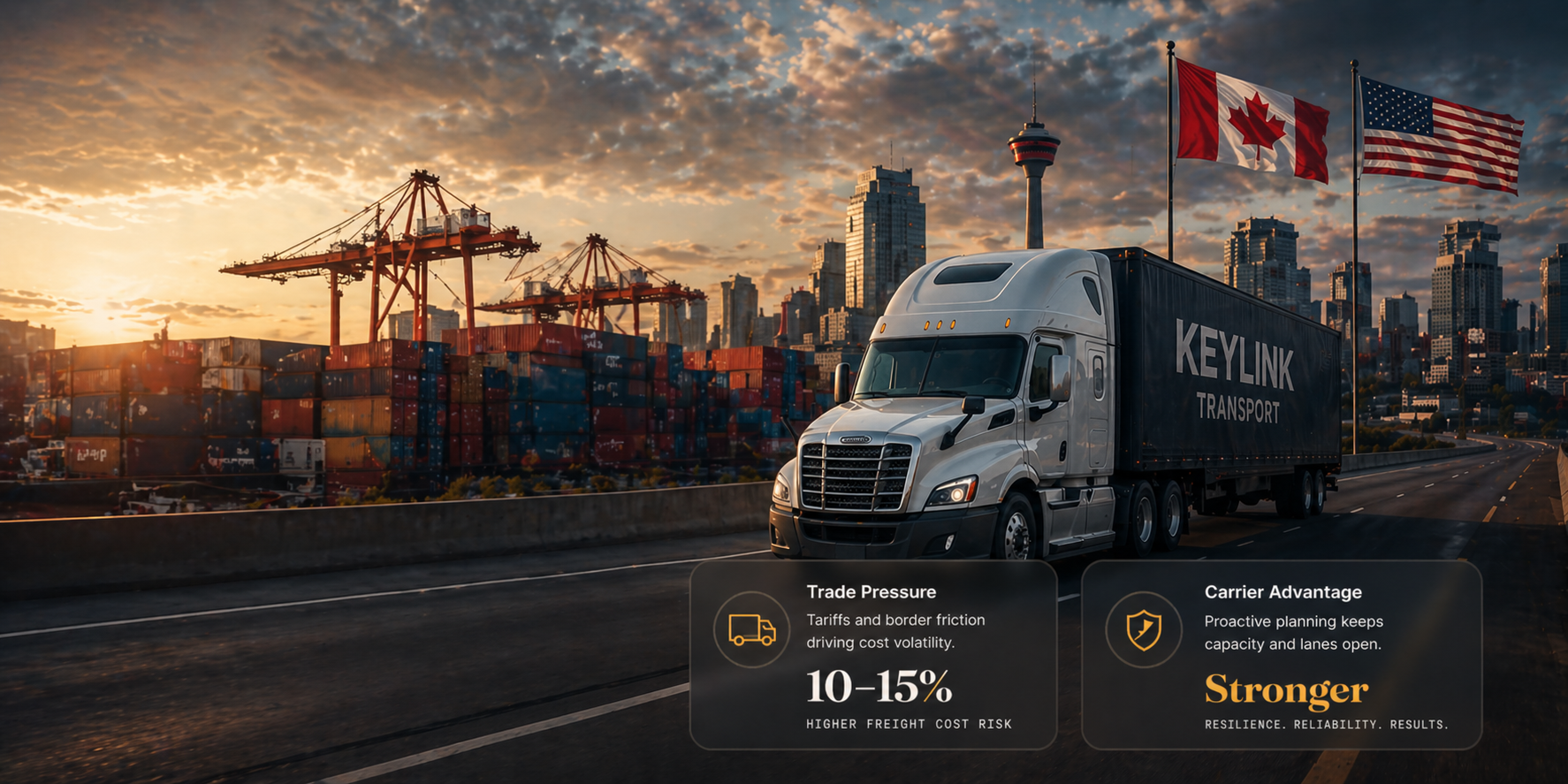
On the evening of Monday, November 25, 2024, President-elect Donald Trump posted on Truth Social that he would sign an executive order on his first day in office imposing a 25% tariff on all goods imported from Canada and Mexico. He tied the tariffs to border security, fentanyl trafficking, and illegal migration. The announcement landed with about 56 days of warning before the January 20, 2025 inauguration, and the Canadian freight industry has been moving ever since.
By Tuesday morning, tender volumes across the Southern Ontario, Quebec, and Prairie-to-US lanes had begun to spike. Shippers that had been planning a measured first-quarter 2025 push were pulling forward Q1 volume into December and the first two weeks of January. Reuters' coverage of the November 25 announcement confirmed the scope: all Canadian and Mexican goods, flat 25% rate, effective "on my first day in office."
Whether the tariffs actually take effect on January 20 as announced, get negotiated down, or end up in an escalating trade dispute is still unknown. What is already certain is that cross-border freight is surging now, capacity is tightening, and rates are climbing. This article walks through what is happening on the lanes this week, which Canadian sectors are most exposed, and what shippers should be doing between now and inauguration day.
What Trump Actually Announced on November 25
The Truth Social post was characteristically unscripted but surprisingly specific. Trump framed the tariffs as leverage over border security and fentanyl, promising to maintain them until both Canada and Mexico "properly use this power" to stop what he described as cross-border flows of drugs and migrants. He also announced an additional 10% tariff on Chinese goods in a separate post. The US government's authority to impose emergency tariffs runs through the Section 301 framework of the Trade Act of 1974 and the International Emergency Economic Powers Act (IEEPA), either of which could legally support an executive-order tariff.
Prime Minister Justin Trudeau called Trump directly on November 26, and Ottawa is signalling that further in-person talks are being arranged. Canadian Finance Minister Chrystia Freeland has begun consultation with provincial premiers about potential Canadian countermeasures, and CBC's reporting on the diplomatic response captures the full scope of Ottawa's scramble.
The Pre-Inauguration Freight Surge Is Already Here
What Carriers Are Seeing This Week
Cross-border carriers are reporting tender volume increases of 15 to 30% on southbound lanes compared to the same week last year. Inbound Canadian RFPs for January and early February freight are being pulled forward into December. The traditional post-Thanksgiving lull in cross-border volume is not materializing this year; instead, many lanes are running close to peak levels. The Journal of Commerce reported on November 26 that drayage and port-of-entry trucking capacity is tightening from Buffalo to Detroit to Blaine.
Rate Implications
Spot rates on Toronto-Chicago, Montreal-NYC, and Vancouver-Seattle lanes moved 5 to 10% higher in the 48 hours after the announcement. Contract rates are more sticky, but shippers with expiring contracts are finding carriers unwilling to lock in long-term commitments at pre-announcement levels. Fuel surcharge programs are also being recalculated as diesel futures moved on expectations of broader economic disruption.
"Every shipper with Canadian-origin inventory destined for US customers is now trying to land it in the US before January 20. Capacity that was comfortable in early November is tight this week, and will be tighter in December."
Which Canadian Sectors Are Most Exposed
Automotive
The Canadian auto sector is the single most exposed industry. Approximately 1.2 million vehicles and billions of dollars in parts cross the Canada-US border annually, most of it through the integrated Ontario-Michigan supply chain. A 25% tariff on finished vehicles would effectively end Canadian-assembled vehicle exports at current pricing. A 25% tariff on parts would disrupt US auto assembly plants that rely on just-in-time Canadian components. The Canadian Vehicle Manufacturers' Association has been publicly lobbying for exemption or CUSMA preservation since the announcement.
Energy
Canada supplies approximately 60% of US crude oil imports and roughly 98% of natural gas imports. Whether energy is included in a blanket tariff is a critical open question. Trump has previously indicated energy tariffs are on the table, but US refiners in the Midwest are heavily dependent on Canadian heavy crude that cannot be easily substituted. Expect significant lobbying effort to keep energy exempt or at a reduced rate.
Agri-food
Canadian agri-food exports to the US totaled approximately $40 billion in 2023. A 25% tariff would hit beef, pork, grain, processed foods, and produce. Canadian processors with short-shelf-life inventory (dairy, fresh meat, produce) cannot easily pre-ship ahead of the January 20 deadline the way durable goods can, which puts this sector at disproportionate risk.
Forest Products and Lumber
Canadian softwood lumber has been subject to ongoing duties for years, and a 25% tariff would stack on top of existing countervailing duties. US homebuilders have already begun pricing in cost increases on lumber contracts stretching into Q1 2025.
The CUSMA Question
The Canada-United States-Mexico Agreement (CUSMA), known as USMCA in the US, is a free trade agreement signed during Trump's first term in 2018 and scheduled for a mandatory six-year review in 2026. A 25% tariff on all Canadian goods would be a direct violation of the CUSMA's preferential tariff commitments. The legal question is whether Trump can impose the tariff under IEEPA or similar emergency authority notwithstanding CUSMA, or whether Canada and Mexico would have grounds to invoke the CUSMA's dispute resolution mechanisms.
The practical answer is that the United States can impose almost any tariff it chooses and make Canada sue to reverse it. Dispute resolution under CUSMA takes months to years. The tariffs will be in place long before any ruling. Ottawa's leverage therefore has to come from reciprocal tariffs and political pressure on US constituencies (auto workers in Michigan, refiners in the Midwest, farmers in the agricultural Midwest) that would be harmed by the trade disruption. The Global Affairs Canada overview of CUSMA provides the formal framework, though the document was not drafted to contemplate a unilateral tariff announcement of this scale.
The Shipper Playbook for the Next 60 Days
If you ship Canadian-origin goods to US customers, or import US goods into Canada for onward distribution, the next 60 days matter. Here is a practical checklist:
- Pull forward Q1 volume where you can. Any order that can legitimately ship before January 20 and clear US customs before inauguration should be accelerated. Warehouse capacity in Pennsylvania, Ohio, New York, and Washington State is being booked aggressively this week. Book yours before rates move further.
- Lock in carrier capacity now, not in January. Spot-market January capacity is likely to be brutal. Contract commitments made this week are the cheapest capacity you will see for the next 90 days.
- Document country-of-origin rigorously. Tariffs apply at the HTS classification level. Canadian value-added manufacturers that import inputs from third countries need to confirm their rule-of-origin qualifications under CUSMA. If the tariffs include a CUSMA exemption, rule-of-origin compliance is your protection.
- Review your Incoterms. DDP (Delivered Duty Paid) shipments mean you absorb the tariff. FCA or FOB shipments mean your US customer absorbs it. If you are on DDP terms, get in front of your customers now about how tariffs will be handled.
- Model your business at 25% tariff cost. If the tariffs are imposed and not quickly withdrawn, what does your pricing need to look like? Who can absorb what portion? Which product lines become unprofitable? Model this now, while you have time, not in February when you are reacting in real time.
- Diversify your carrier roster. The carriers that will serve you best in a volatile trade environment are the ones with flexible capacity, proactive communication, and cross-border specialization. Now is the time to qualify backup capacity, not when your primary carrier's trucks are tied up at a border queue.
What Happens After January 20
The honest answer is that nobody knows. The most likely scenarios, in rough order of probability:
- Partial or phased implementation: Trump announces the tariffs but includes carve-outs for energy, CUSMA-compliant goods, or specific sectors. The 25% headline figure becomes a negotiating anchor rather than a uniform rate.
- Full implementation followed by negotiation: Tariffs go into effect on January 20 as announced. Canada and Mexico impose retaliatory tariffs within days. Both sides negotiate a settlement over 30 to 120 days that reduces or eliminates the tariffs in exchange for border security commitments or other concessions.
- Extended trade war: Tariffs escalate rather than settle. Canadian countermeasures expand. The freight market adjusts to a new steady-state of higher cross-border cost, lower volume, and routed supply chain changes. This is the worst-case scenario and the one carriers should have contingency plans for, even if they do not expect it.
- Withdrawal or postponement: The tariff announcement was always intended as negotiating leverage. Before inauguration, or within days of it, Trump announces a "deal" with Canada and Mexico that trades tariff withdrawal for border security action. This is the best-case scenario but should not be assumed.
Whatever happens on January 20, Canadian shippers need a cross-border carrier that communicates early, commits capacity, and adapts routing in real time. Keylink Transport has been running the BC-Washington corridor since day one and we are built for this kind of environment.
Book a Load →The Bottom Line
The next 56 days are going to be loud. Tender volumes are up, rates are firming, capacity is tightening, and every Canadian shipper with US customers is rethinking their January and Q1 plans. The shippers who move fastest to book capacity, pull forward shippable volume, and lock in carrier commitments will ride through the disruption with the least damage.
The shippers who wait to see what happens on January 20 before acting will find themselves competing for scarce January capacity at spot-market rates, with no negotiating leverage and no forward plan. For a trade relationship that moves $2.7 billion in goods across the Canada-US border every single day, "wait and see" is not a strategy. It is a decision to be reactive.