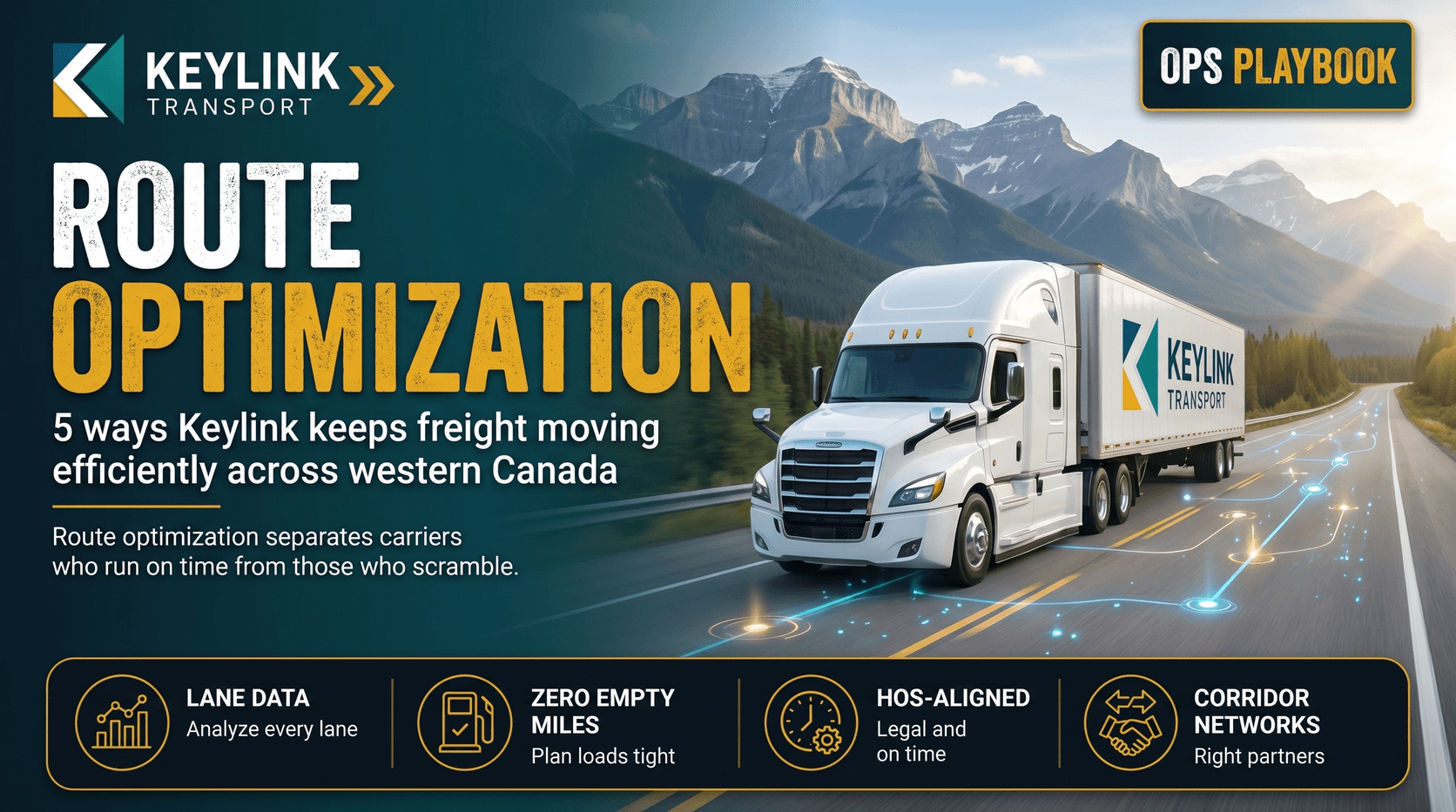
Route optimization is one of those terms that gets used loosely in logistics conversations. For some carriers, it means plugging addresses into a mapping app. For the carriers who consistently deliver on time and keep operating costs under control, it means something more systematic: a disciplined approach to understanding which lanes to run, how to load them, when to depart, and which tools amplify every decision along the way.
At Keylink, route efficiency is not an afterthought. It is built into how we dispatch, plan, and scale. Here are five strategies that make the difference between a freight network that grinds and one that runs.
Start with Lane-Level Data Analysis
Most carriers know their overall cost per mile. Fewer know their cost per lane, per season, per day of the week. That gap is where inefficiency hides. A lane that looks profitable on average can be dragging down your network on specific days when border wait times spike, construction adds hours to transit time, or receiver appointment slots push departure schedules into expensive overtime windows.
Start by pulling 90 days of lane-level data: actual transit times, fuel consumption, driver hours, and any accessorial charges. Segment that data by day of week and month. You will almost always find patterns, and those patterns are where your optimization budget should go first. The Canadian Trucking Alliance tracks corridor performance data that can benchmark your findings against industry averages.
On the BC-Alberta corridor, we have found that Tuesday and Wednesday departures from the Lower Mainland consistently outperform Monday loads in transit predictability, largely because weekend congestion at the Port of Vancouver clears by Tuesday morning. That single scheduling insight, derived from data, improves on-time delivery without adding a dollar in cost.
Plan Loads to Eliminate Empty Miles
Empty miles are pure cost with zero revenue. For a carrier running a dedicated corridor, the return leg is the biggest variable in the profitability equation. If your outbound lane is full but your return is empty 40 percent of the time, your effective cost per revenue mile is much higher than your accounting shows.
The fix is not complicated in principle, though it requires discipline in execution. Build relationships with shippers whose freight flows in the opposite direction of your primary lanes. Reach out to freight brokers who specialize in backhaul markets on your corridors. Consider whether your network has complementary lanes, where a driver who runs Vancouver to Calgary can pick up a partial-load backhaul to Kelowna before repositioning for the next outbound run.
Align Driver Schedules with HOS Regulations
Hours of service regulations under Transport Canada and the FMCSA are not just compliance requirements. When used intelligently, they are a planning framework that helps you design routes that drivers can actually complete without shortcuts or fatigue-related risks.
A common mistake is dispatching loads based on shipper pickup requests without checking whether the required transit time fits within the available HOS cycle for your assigned driver. When those two variables are misaligned, drivers either push legal limits, which creates safety and compliance risk, or they stop short of delivery, which creates service failures.
The solution is to build your dispatch process around driver cycle availability first. Know how many hours each driver has before pickup, and plan departure times accordingly. On longer FTL runs, identify compliant rest locations in advance so drivers are not hunting for parking at the end of a 10-hour shift. Predictable rest planning also protects equipment: trucks parked in unsafe areas get damaged at higher rates than those stopped at approved facilities.
Use Technology as a Force Multiplier
ELD data is the foundation. Every carrier subject to FMCSA or Transport Canada mandates is already capturing real-time location, speed, and hours data through their ELD system. The question is whether your dispatch team is actually using that data, or just storing it for compliance purposes.
Carriers who get maximum value from their ELD investment connect that data to dispatch software so that available hours, current location, and estimated arrival times are visible in one screen. When a driver is running behind due to weather on the Coquihalla, dispatch should know 90 minutes before appointment time, not when the driver calls to report a delay. That advance visibility is what allows proactive customer communication and recovery planning.
"The best route optimization tool is not software. It is a dispatcher who knows the corridor, reads the data, and makes judgment calls faster than any algorithm."
Beyond ELD, invest in weather and traffic monitoring for your primary corridors. Apps and platforms that provide real-time road condition alerts for mountain passes in BC and Alberta can mean the difference between a driver making it through before a closure and sitting for six hours waiting for a plow. That six hours is lost capacity that compounds across your entire schedule.
Build Corridor-Specific Carrier Networks
No single carrier has perfect coverage on every lane in every season. The carriers who serve their customers best are those who have honest conversations about where their network is strongest and who they partner with for lanes outside that core.
For shippers, this means asking potential carriers to be explicit about which lanes they operate with their own assets versus which they broker out. Asset-based carriers on your primary corridors will almost always outperform brokered arrangements on consistency, communication, and compliance. Industry organizations like the Canadian Trucking Alliance maintain directories of vetted carriers by region and specialty.
For carriers, building reciprocal relationships with trusted partners on complementary lanes allows you to serve shippers on their full freight network, not just the lanes you cover directly. A shipper who trusts you to coordinate their BC-Alberta lane will give you the cross-border lanes too, if you can demonstrate a reliable network for execution.
Keylink operates dedicated FTL lanes across BC, Alberta, and into the US Pacific Northwest. Talk to our team about optimizing your freight program.
Talk to Our Team →

