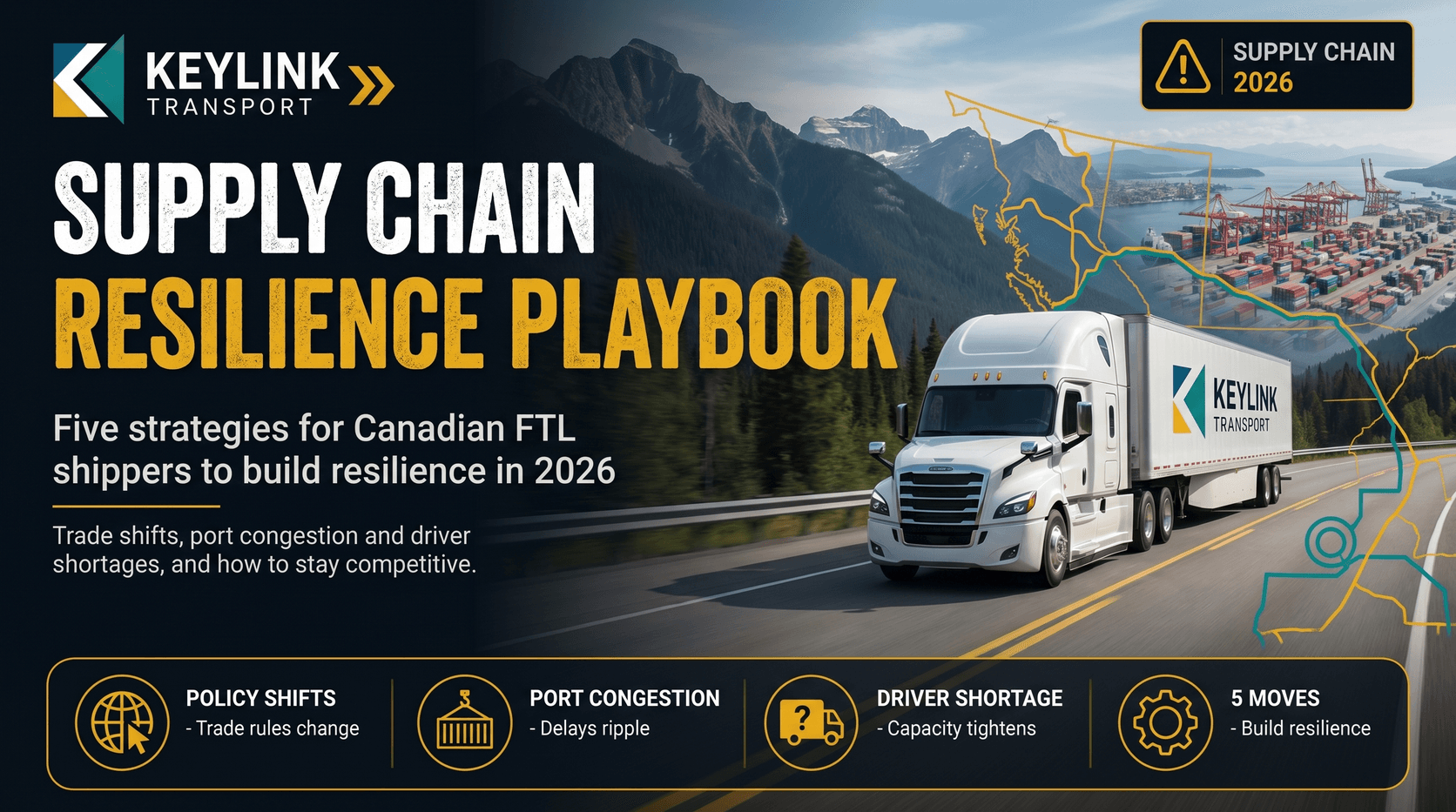
The Canadian freight landscape in 2026 is being reshaped by forces that few supply chain managers anticipated just eighteen months ago. The convergence of shifting US-Canada trade policy, sustained capacity constraints, accelerating climate events across western corridors, and a deepening driver shortage has transformed what were once predictable freight lanes into sources of daily operational risk.
For Canadian businesses moving goods across the border,particularly shippers operating on the BC-Alberta corridor and into US Pacific Northwest markets,the stakes have quietly escalated. A delay costs money. A surprise costs customers. In a freight environment where margins are already compressed, the operations that adapt fastest will hold the competitive advantage.
This guide breaks down the five most significant disruption drivers affecting Canadian FTL shippers today, quantifies the real cost of inaction, and offers five concrete strategies you can act on now.
What's Driving Today's Disruptions
1. US-Canada Trade Policy Shifts
The most consequential factor in Canadian cross-border freight in 2026 is the evolving tariff landscape between Ottawa and Washington. Proposed and enacted duties on Canadian exports,affecting sectors from softwood lumber and aluminum to certain manufactured goods,have created both direct cost increases and secondary effects on freight economics. Border processing times at major Canada-US crossings have extended as CBP officers manage heightened compliance scrutiny on tariff-affected commodity classes.
The Canadian Trucking Alliance (CTA) has documented the operational burden on carriers navigating these changes, noting that additional documentation requirements and inspection frequencies are adding meaningful time to cross-border transit schedules. For shippers, this means more buffer time needs to be built into cross-border delivery commitments.
2. Port and Rail Congestion at Vancouver and Prince Rupert
The Port of Vancouver,Canada's busiest, handling over 140 million tonnes of cargo annually,is operating under sustained congestion pressure. Dwell times for international containers have extended as vessel volumes recover while labour and equipment capacity have not scaled proportionally. Prince Rupert has absorbed some overflow, but rail connections to inland distribution points remain bottlenecked.
For FTL shippers, port congestion translates into tighter pickup windows at distribution centres fed by these terminals,and cascading delays when a single vessel's late arrival shifts demand across an entire distribution network in a single afternoon.
3. The North American Driver Shortage
The Trucking HR Canada projects a shortage exceeding 40,000 vacancies by 2030. That future is already present: capacity is meaningfully tighter than rate sheets suggest on busy western Canada lanes. Quality carriers,those operating with clean safety records, full ELD compliance, and verified cross-border operating authority,are running at capacity months ahead on their best lanes.
For shippers who rely on a single carrier relationship, this creates a structural vulnerability that a disruption event can expose with very little warning.
4. Fuel and Operating Cost Volatility
Diesel prices across BC and Alberta have remained volatile throughout 2025-2026, responding to global crude markets, provincial carbon levies, and seasonal demand cycles. For shippers negotiating spot rates or operating under older fixed-rate agreements, fuel volatility introduces budget unpredictability that compounds downstream. Carriers absorbing unsustainable fuel costs either raise rates on short notice or pull capacity from unprofitable lanes,both outcomes that hurt shippers.
5. Climate Events on Western Corridors
The atmospheric river events that devastated BC's transportation infrastructure in late 2021 established a precedent the freight industry has not forgotten. Highway 1, the Coquihalla, and the Fraser Canyon remain potential single points of failure for east-west freight movement through the province. Transport Canada's own infrastructure resilience assessments have flagged climate vulnerability across western corridors as an ongoing concern. Shippers without contingency routing plans are one season away from a potentially severe disruption.
The Real Cost of Disruption
The visible cost of a supply chain disruption,the delayed shipment, the missed delivery window,is usually the smallest part of the total bill. The full cost often unfolds slowly, across multiple teams and budget lines:
- Customer attrition: A single significant delay can fracture a shipper-client relationship built over years. In industries with thin competitive differentiation, delivery reliability is often the primary differentiator.
- Inventory carrying costs: Longer and less predictable transit times force safety stock increases, tying up working capital and warehouse space at a real cost that rarely appears on a freight invoice.
- Compliance and border costs: Cross-border shipments that stall at the Canada-US border accumulate CBSA inspection fees, re-inspection costs, and potential customs holds,all billable to the importer or shipper of record.
- Demurrage and detention: Congested ports and tight carrier schedules mean containers and trailers sitting on equipment beyond free time,at the shipper's expense, often at rates that compound daily.
"The average cost of a major supply chain disruption for a mid-size Canadian manufacturer exceeds $200,000,not including reputational damage or downstream customer relationship effects."
5 Strategies for Canadian Shippers
The shippers who weather supply chain disruptions best share a common trait: they stopped treating freight as a commodity purchase and started treating it as a strategic relationship. Here are five concrete moves to make now.
Diversify Your Carrier Network
Single-carrier dependency is a supply chain liability. Build active relationships with two or three core carriers on your highest-volume lanes,ideally carriers with cross-border authority, verified safety records, and ELD-compliant fleets. When primary capacity goes offline, you have coverage within hours, not days.
Build Buffer Inventory at Strategic Nodes
Where your supply chain can absorb it, positioning inventory closer to demand centers builds resilience against upstream disruption. Distribution arrangements near the BC-Alberta border or in the Lower Mainland reduce exposure to long-haul delay cascades. This runs counter to JIT orthodoxy,but the past four years have demonstrated that JIT is a fair-weather strategy.
Demand Real-Time Visibility
You cannot manage what you cannot see. Real-time GPS tracking, automated ETA notifications, and carrier performance dashboards have moved from competitive advantage to operational baseline. Ask every carrier you use what tracking visibility they provide,and hold them to it contractually. During disruption events, knowing your freight's real-time status is the difference between proactive communication and explaining a missed delivery after the fact.
Lock In Rates and Lanes Contractually
Spot market exposure is one of the fastest ways to erode a freight budget during a disruption period. Shippers who negotiate contractual rates on core lanes,even at a modest premium above current spot,buy predictability that outweighs the cost premium over a full fiscal year. With the driver shortage worsening, available capacity will only get tighter. Structure rate agreements with fuel surcharge mechanisms rather than fixed all-in rates to give carriers stability and reduce the risk of capacity being pulled when spot rates spike.
Strengthen Cross-Border Compliance Fundamentals
Cross-border FTL shipments are subject to CBSA and US CBP regulations,including customs broker requirements, commodity-specific documentation, and ELD compliance for drivers operating under FMCSA authority. A single documentation error can result in multi-day holds at the border. The marginal savings from using a non-compliant carrier on a cross-border lane will never cover the cost of a single delayed shipment.

The BC-Alberta Corridor Advantage
Not all freight corridors are created equal,and not all carriers understand the nuances of the western Canada lanes. The BC-Alberta corridor serves as the primary gateway for goods moving between Canada's two largest western provinces, and as the entry point for cross-border freight heading south into Washington, Oregon, and California.
Carriers who operate on these lanes daily have route knowledge, regulatory familiarity, and established relationships with border crossings that brokers and national carriers often lack. For shippers moving time-sensitive FTL freight on western Canada lanes, working with a carrier that calls this corridor home is a meaningful operational advantage.
Key considerations for cross-border FTL on the BC-Alberta-Pacific Northwest triangle:
- CBSA export reporting: Commercial shipments crossing from Canada to the US must be reported to CBSA and cleared through CBP. Carriers with established commercial import/export procedures expedite this process significantly.
- FMCSA operating authority: Carriers operating in the US must hold active FMCSA authority. Verify your carrier's MC number and safety rating on the FMCSA portal before tendering cross-border freight.
- ELD compliance: Electronic Logging Devices are mandatory for commercial motor vehicles in both Canada and the US. Non-compliant drivers can be placed out of service at the border,stalling your freight indefinitely.
- Route contingency planning: On the BC side, every shipper should have a secondary route plan for events that affect the Coquihalla or Highway 1. Carriers who know the corridor know the alternates.
How Keylink Transport Helps Canadian Shippers Stay Ahead
At Keylink Transport, we operate dedicated FTL capacity on the lanes that matter most to western Canadian shippers: the BC-Alberta corridor, cross-border lanes into Washington and Oregon, and select Pacific Northwest routes. We built this business around the challenges outlined in this article,and we've structured our operations to address them directly.
- Dedicated fleet, no brokered loads: Your freight moves in our equipment, with our drivers, under our authority. Full chain-of-custody from pickup to delivery.
- Active cross-border authority: USDOT 2832041 | MC# 946449. We operate legally and compliantly on both sides of the border, with established CBSA and CBP clearance procedures.
- Real-time tracking on every load: You know exactly where your freight is at any point in transit. No uncertainty, no chasing dispatch for updates.
- Experienced operations team: Available to handle exceptions, route changes, and border complications,not just during regular business hours.
- Clean safety record: No CSA violations. ELD-equipped fleet. Fully FMCSA-compliant. You can verify our safety profile on the FMCSA SMS portal.
- Transparent rate structures: We don't disappear when spot rates spike. Our client relationships are built on consistent, negotiated capacity,not opportunistic pricing.
If you're reviewing your carrier network and want to establish a reliable FTL partner on western Canada's most important freight corridors, we'd welcome the conversation. Explore our full service offering or reach out directly through our contact page.
Talk to our team about dedicated FTL capacity on BC-Alberta and cross-border lanes. No brokered loads. No surprises.
Book a Load with Keylink →The Bottom Line
Supply chain disruptions in 2026 are not temporary anomalies,they are structural features of a freight market that has been permanently reshaped by trade policy shifts, climate pressure, workforce demographic change, and the residual effects of the pandemic on logistics infrastructure.
The Canadian shippers who emerge from this period with stronger operations are those responding with deliberate strategy: diversifying carrier relationships, locking in contractual capacity, demanding real-time visibility, and building operational resilience into their supply chains before the next disruption event forces the issue.
If you found this guide useful, explore our related articles below,or reach out to the Keylink team directly. We're building long-term carrier relationships with Canadian shippers who understand that reliability isn't just a feature. It's the product.