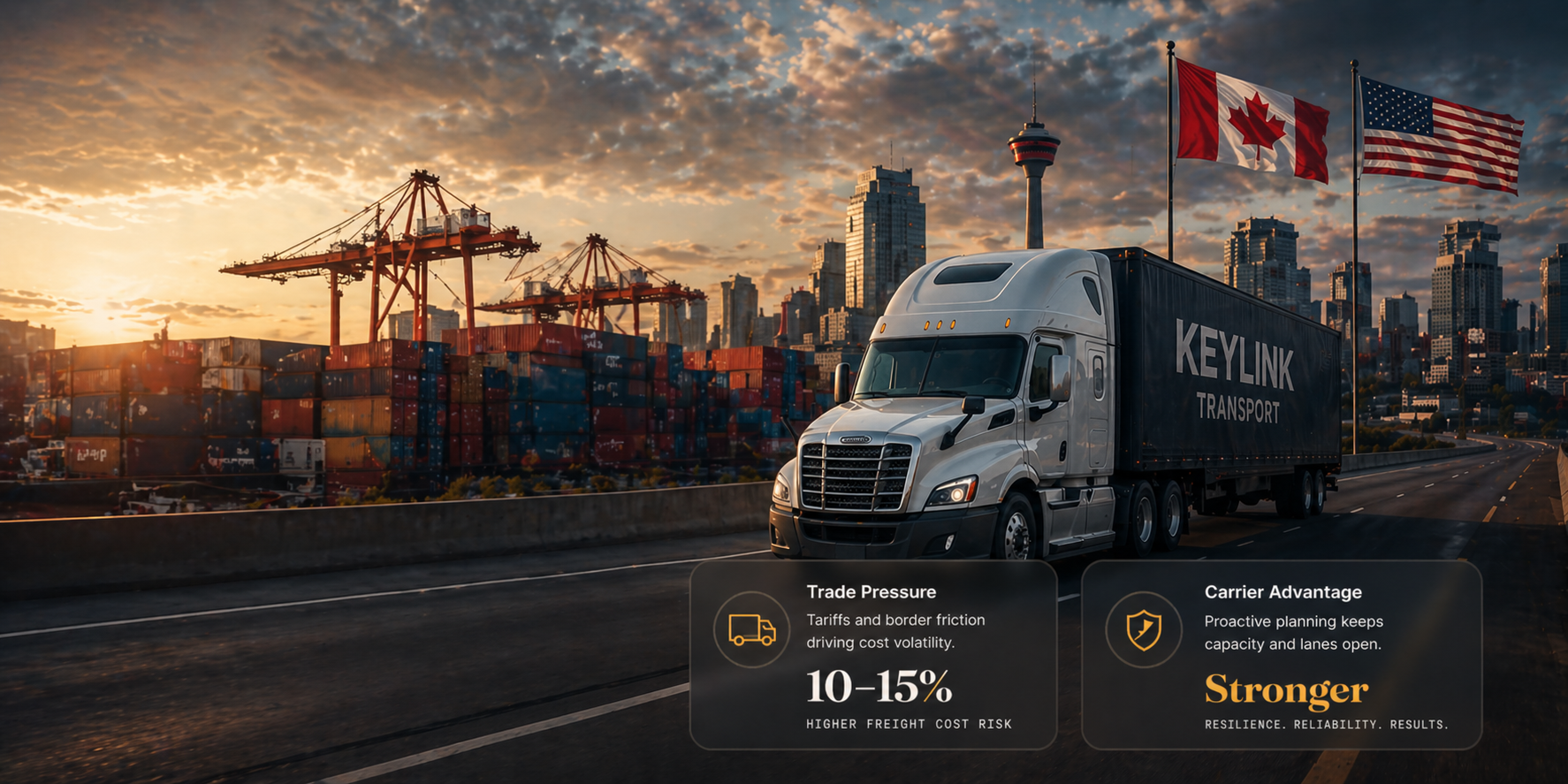
2024 closes the way it started: with a freight recession that won't quit and a political environment that won't stop changing. Twenty-eight months into the worst sustained Canadian trucking downturn in modern memory, with a Trump tariff threat scheduled for Day One of 2025, with a Canada Post strike resolution still in litigation, and with a year of cascading disruptions that compressed every form of supply chain stress into 365 days.
The carriers reading this in late December are the ones who made it through. Many didn't. This is the year-end recap of how the freight market got here, what stayed standing, and what's set up for 2025.
A Year of Shocks
The shape of 2024 was not one big event. It was a calendar of medium-sized events, each one big enough to consume freight management attention for two to four weeks, each one followed by another before the previous one resolved. FreightWaves' 2024 retrospective coverage counted nine major freight-disrupting events, the most in a single year since 2020.
The cumulative effect was to keep the freight market in a permanent state of partial readjustment. Carriers that stayed disciplined - density on lanes, retention of drivers, transparent communication with shippers - kept their margin steady. Carriers that chased rate or volume on every disruption ended the year worse than they started.
Freight Economics: A 28-Month Recession
The Canadian freight recession entered its 28th consecutive month in December 2024. The Canadian Trucking Alliance's year-end industry summary tallied roughly 19,000 motor carriers exiting the for-hire market across all of 2024, the highest single-year exit total on record.
Spot rates ended the year at $1.99 per mile (excluding fuel), 3% higher than Q4 2023 in nominal terms but flat in real terms. Cross-border lanes outperformed domestic regional dry van. Reefer rates remained depressed. Flatbed held best, supported by Western Canadian energy and infrastructure activity.
The Events That Defined the Year
For the freight market, twelve events stood out. The Baltimore Key Bridge collapse on March 26 reshaped East Coast supply chain routing for months. The Red Sea Houthi crisis kept Asia-Europe shipping on the Cape of Good Hope route through the entire year. The CrowdStrike outage on July 19 grounded global trucking for three days through TMS and dispatch system failures. Bangladesh's political collapse on August 5 reshaped global garment supply chains.
"In a normal year, any one of these events would dominate the freight headlines. In 2024, we got nine of them. The lesson is that resilience is now the central operational competence in trucking, not the optional one." - Canadian fleet operator, year-end interview
Hurricane Helene devastated the US Southeast in late September. The ILA strike shut 36 East Coast and Gulf ports for three days at the start of October. Hurricane Milton struck Florida a week later. Trump won the November 5 election with explicit tariff intent. The Canada Post strike began November 15 and ran through December 17. South Korea's martial law crisis on December 3 raised supply chain questions across Asia-Pacific. Bashar al-Assad's regime fell on December 8, reshaping the Mediterranean and Red Sea shipping outlook.
Carrier Survival in a Stalled Market
The year's freight statistics are difficult to reconcile with what survived carriers actually report. Spot rates flat. Carrier exits at all-time highs. Volume slightly lower year-over-year. And yet, the carriers that built proper foundations during the 2021 boom and held discipline through the recession came through 2024 leaner, more focused, and better positioned than they were a year ago.
Three patterns separated survivors from exits. Lane density discipline: carriers with 60-70% paired-load utilization on cross-border and BC-Alberta lanes outperformed generalists. Driver retention investment: turnover under 35% became a competitive moat as driver supply tightened. Customer communication cadence: carriers who picked up the phone proactively during disruption events kept shippers through Q4 better than those who waited for invoices to spark conversations.
What 2024 Set Up for 2025
The 2025 calendar already has hard dates on it. January 15: the ILA-USMX master contract deadline. January 20: Trump's inauguration with the threatened Day-One 25% tariff on Canada and Mexico. Q1: ongoing Liberal cabinet turmoil following Chrystia Freeland's December 16 resignation, with parliamentary fallout still uncertain. Spring: anticipated US reciprocal tariff announcements.
For Canadian carriers, the H1 2025 operating reality is now visible: tariffs, ILA contracts, federal political turbulence, and another spike in supply chain tension. Carriers and shippers who finished 2024 with disciplined fundamentals will be better positioned to absorb whatever lands.
Thank You
2024 was a hard year. Driver retention was harder than it should have been because the market punishes patient capital. Insurance renewals burned more cash than they should have because the courts and the underwriters didn't see what we see on the road. Shipper conversations were harder than they should have been because the market told everyone that the lowest quote was the right answer.
And yet. The trucks moved. Drivers showed up. Dispatchers picked up the phone. Brokers cleared paperwork. Shippers honoured contracts. Carriers kept paying drivers. The freight network did what it always does, even when the headline numbers don't reflect the work.
To every Keylink driver who ran cross-border in this market, every shipper who chose us through a year that gave them every reason to procurement-shop, and every team member who showed up: thank you. The year was hard. The work was good. The trucks have to keep moving in 2025. We will keep moving them.
See you in January.