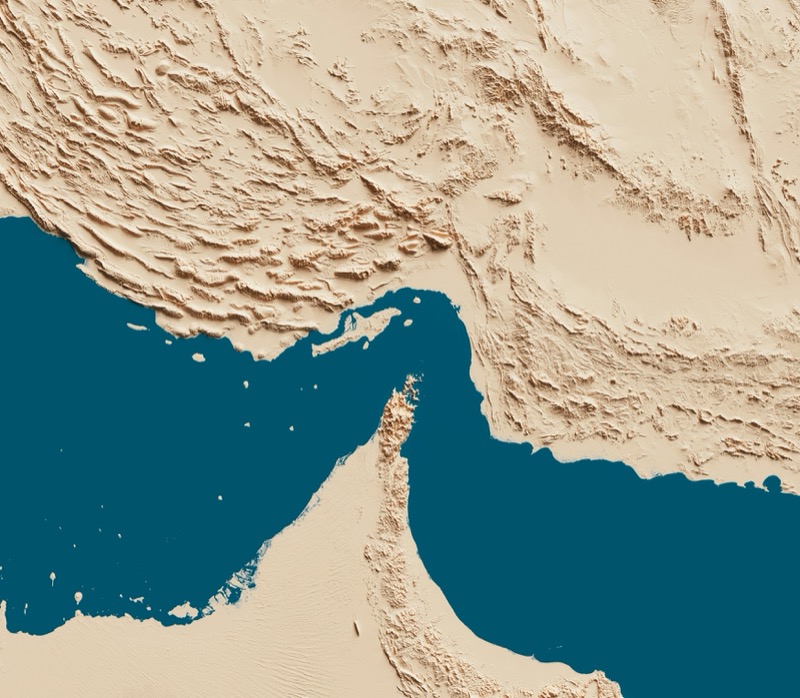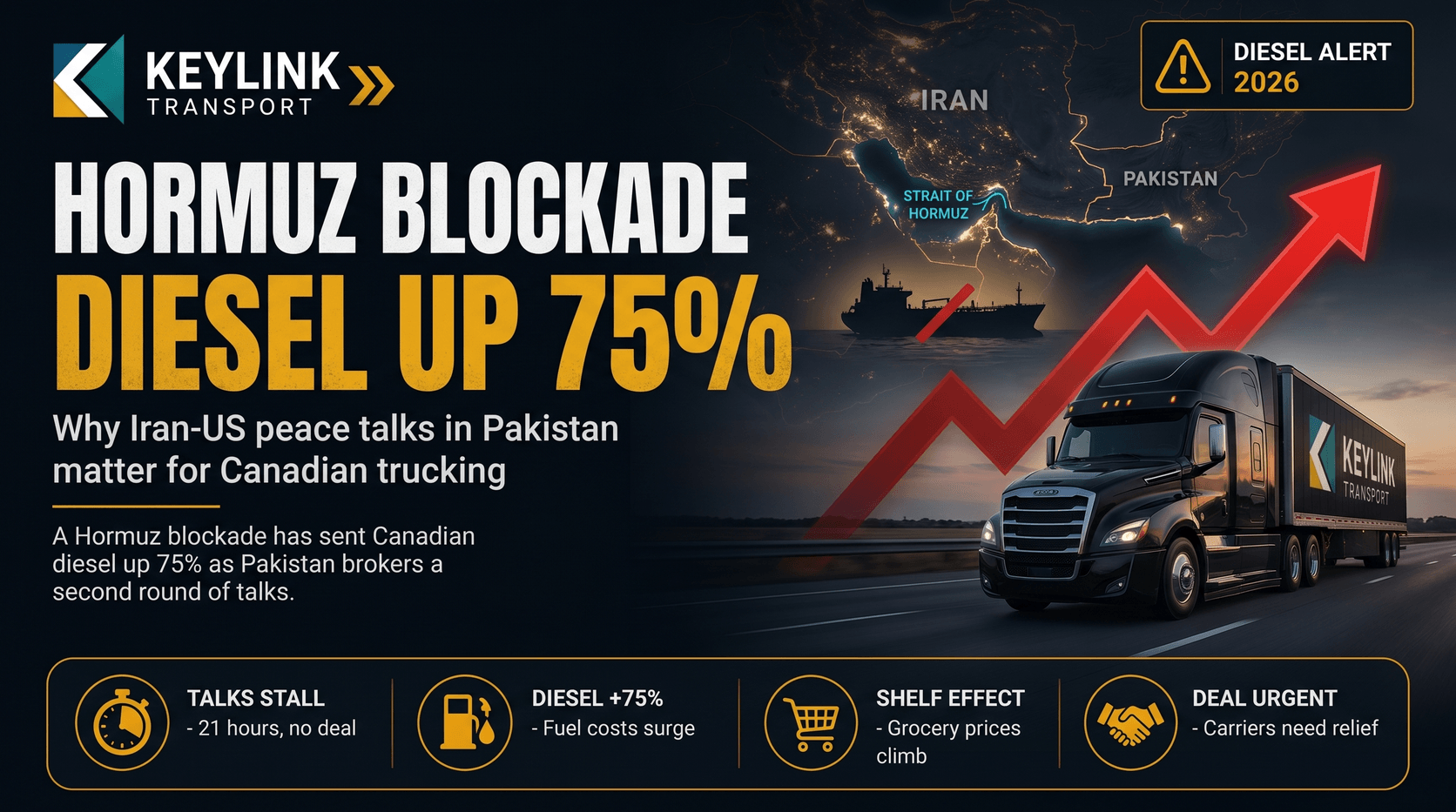
Seven weeks ago, the United States and Israel launched coordinated airstrikes on Iran under Operation Epic Fury. The Strait of Hormuz, the narrow waterway that carries roughly 20% of the world's oil and liquefied natural gas, has been effectively closed ever since. Canadian diesel prices have surged 75%. Small carriers are bleeding cash. And the only diplomatic lifeline on the table right now runs through Islamabad, Pakistan.
On April 11 and 12, 2026, US and Iranian negotiators sat across from each other in Pakistan's capital for 21 hours of marathon talks. They left without a deal. Now Pakistan is pushing hard for a second round, with its army chief travelling to Tehran and its prime minister making stops in Riyadh and Ankara to build consensus. The outcome of these talks will determine whether Canadian trucking faces weeks or months of crisis-level fuel costs.
This is not a distant geopolitical story. This is a story about what it costs to fill a truck in Abbotsford today.
The Islamabad Talks: 21 Hours, No Deal
The first round of direct Iran-US negotiations, known as the Islamabad Talks, took place on April 11-12, 2026. Pakistan brokered and hosted the discussions, with Field Marshal Asim Munir playing a central mediating role.
The talks lasted 21 hours across three rounds. The first session was indirect, with Pakistan shuttling messages between the two delegations. The second and third sessions were direct, face-to-face negotiations. US Vice President JD Vance led the American side.
The talks collapsed without agreement. Vance publicly stated that Tehran had refused to accept Washington's terms, while Iran's delegation pointed to what it called unacceptable preconditions.
Why the First Round Failed
The gap between the two sides remains enormous. Understanding what each side demanded helps explain why a second round is so critical.
The US Proposal
- Complete dismantlement of Iran's nuclear program
- Limits on Iran's ballistic missile capabilities
- Immediate reopening of the Strait of Hormuz to all commercial traffic
- Restrictions on Iran's support for armed groups in Lebanon, Iraq, and Yemen
- In exchange: phased sanctions relief for Iran
Iran's Five-Point Counter-Proposal
- An immediate end to all US-Israeli military operations against Iran
- Binding security guarantees preventing future US and Israeli aggression
- War reparations for damage caused by Operation Epic Fury
- International recognition of Iranian sovereignty over the Strait of Hormuz
- Full, unconditional sanctions relief
According to Time's analysis of the breakdown, neither side was willing to move on the core issues of Iran's nuclear program and the status of Hormuz. These are the two issues that matter most for global freight.
Pakistan Pushes for Round Two
Within hours of the first round ending, Pakistan began pushing for another attempt. Field Marshal Asim Munir flew to Tehran for direct meetings with Iranian officials. Pakistan's Prime Minister simultaneously visited Saudi Arabia, Qatar, and Turkey to build regional support for continued talks.
The White House has signalled willingness to return. Press Secretary Karoline Leavitt called the Pakistan-mediated discussions "productive and ongoing" and confirmed that Islamabad would likely host a second round. Pakistani sources have indicated a "major breakthrough" may be emerging on the nuclear question.
"We feel good about the prospects of a deal. The discussions with Pakistan have been productive and ongoing." - Karoline Leavitt, White House Press Secretary, April 15, 2026
But no date has been set. And every day without a deal is another day that Canadian carriers pay crisis-level fuel prices.
The Hormuz Blockade by the Numbers
The scale of this disruption is historically unprecedented. The 2026 Strait of Hormuz crisis has been described as the largest disruption to the global energy supply since the 1970s oil crises.
According to CNBC's coverage, the IRGC officially confirmed the strait was closed on March 2, threatening any ship attempting to pass. Roughly 10 million barrels per day of oil production has been restricted. Container shipping rates from Asia to the US West Coast are up approximately 40%, and Asia to North Europe rates have climbed around 20%.
Oil supertanker rates hit all-time highs as insurers dropped war risk protection across the Middle East, making it nearly impossible for vessels to transit even if Iran allowed it.
The Direct Hit on Canadian Trucking
This is where the geopolitics hit the highway. Canadian truckers are now paying over $2.20 per litre for diesel, up from $1.25 per litre before the conflict began. For a four-truck operation, that translates to roughly $700 more per fill-up, per truck.
Small and midsize carriers, which make up two-thirds of Canada's 135,000 trucking businesses, are bearing the worst of it. Fuel historically accounted for 25-35% of a trucking company's yearly running costs. Under current conditions, industry analysts warn that fuel could climb to 45 or 50% of total operating expenditure.
For carriers locked into contracts with fixed fuel surcharge formulas, the math is devastating. Many existing surcharge schedules were calibrated for diesel in the $1.20 to $1.60 range. At $2.20, the surcharge does not cover the actual cost, and carriers absorb the difference on every single load.
"Please help. Truckers are warning that rising diesel costs will drive up food and goods prices across the country. This is not sustainable." - Canadian truckers' open appeal, March 2026
The Grocery Shelf Effect
The damage does not stop at the fuel pump. According to researchers at the University of Guelph, a sustained rise in oil prices adds between one and three percentage points to food inflation in Canada. Under current conditions, grocery inflation could climb back toward 6% to 8%.
The mechanism is straightforward: higher diesel means higher delivery costs on every truck that moves food from warehouse to shelf. But the crisis compounds through a second channel that most consumers do not see.
Fertilizer Costs Are Surging
Nitrogen fertilizer prices have risen more than 70% since the start of 2026. Fertilizer production is heavily tied to natural gas, and the Hormuz blockade has disrupted global LNG flows. Higher fertilizer costs push grain production costs higher, which Retail Insider reports will result in price increases of 3% to 6% on grain-based products.
The combined effect of diesel and fertilizer inflation means Canadian families are being hit twice: once at the pump, and once at the checkout.
Ottawa's Response: Too Little, Too Late?
On April 14, 2026, Prime Minister Mark Carney suspended the federal fuel excise tax on gasoline and diesel, effective April 20 through September 7, 2026. The suspension is expected to reduce diesel costs by approximately 4 cents per litre.
For a truck burning 200 litres of diesel on a single run, that is $8 in savings. On a fuel bill that has increased by $700 per fill-up, the relief is minimal.
The government also expanded the Canada Groceries and Essentials Benefit, covering more than 12 million low- and middle-income Canadians with CAD $11.7 billion over six years. The benefit targets consumers, not carriers, which means the trucking industry itself remains largely on its own.
Keylink Transport builds transparent fuel surcharge structures into every contract. No hidden costs, no surprises when diesel spikes. Talk to our team about freight rates that account for today's reality.
Talk to Our Team →What Carriers and Shippers Should Do Now
Waiting for diplomacy to solve this is not a strategy. Whether the second round of talks produces a deal or not, the freight industry needs to act on the reality in front of it.
Renegotiate Fuel Surcharge Formulas Immediately
If your contracts use a fixed fuel surcharge table, those numbers are outdated. Push for weekly diesel index-linked surcharges that adjust automatically with the Natural Resources Canada fuel price data. Both carriers and shippers benefit from transparency here.
Lock In Rates Where Possible
If you are a shipper with predictable volume, negotiate contract rates now. Spot rates will spike further if talks break down. If you are a carrier, prioritize customers who will commit to volume in exchange for rate certainty.
Optimize Routes and Reduce Empty Miles
At $2.20 per litre, every empty mile costs more than double what it did in January. Consolidate loads, match backhaul opportunities, and cut any route inefficiency that was tolerable at lower fuel prices.
Build Cash Reserves for Extended Disruption
Even if a deal is reached in Round Two, Hormuz will not reopen overnight. Analysts expect elevated fuel prices through at least the end of 2026. Plan your cash flow accordingly and avoid overextending on new equipment commitments.
Communicate Proactively with Customers
Your customers read the same headlines. Get ahead of rate conversations by sharing the data: diesel cost comparisons, fuel surcharge breakdowns, and timeline scenarios. Transparency builds trust, especially in a crisis.
The Bottom Line
The Strait of Hormuz blockade is the single most disruptive event in global energy markets since the 1970s. For Canadian trucking, it has turned fuel from a manageable cost into an existential threat for small and midsize carriers.
Pakistan's diplomatic push for a second round of Iran-US talks is the most promising path to reopening Hormuz. The first round showed that direct negotiations are possible. Pakistani officials are reportedly seeing a "major breakthrough" on the nuclear question. But talks have not been scheduled, a ceasefire deadline is approaching, and oil markets remain volatile.
For carriers and shippers, the message is clear: prepare for both outcomes. If a deal happens, fuel prices will ease, but not immediately. If talks fail, the disruption extends through 2026 and potentially beyond. Either way, the freight industry that emerges from this crisis will operate differently than the one that entered it.
The trucks still need to move. The freight still needs to arrive. The question is what it costs to make that happen, and right now, that answer is being negotiated in Islamabad.