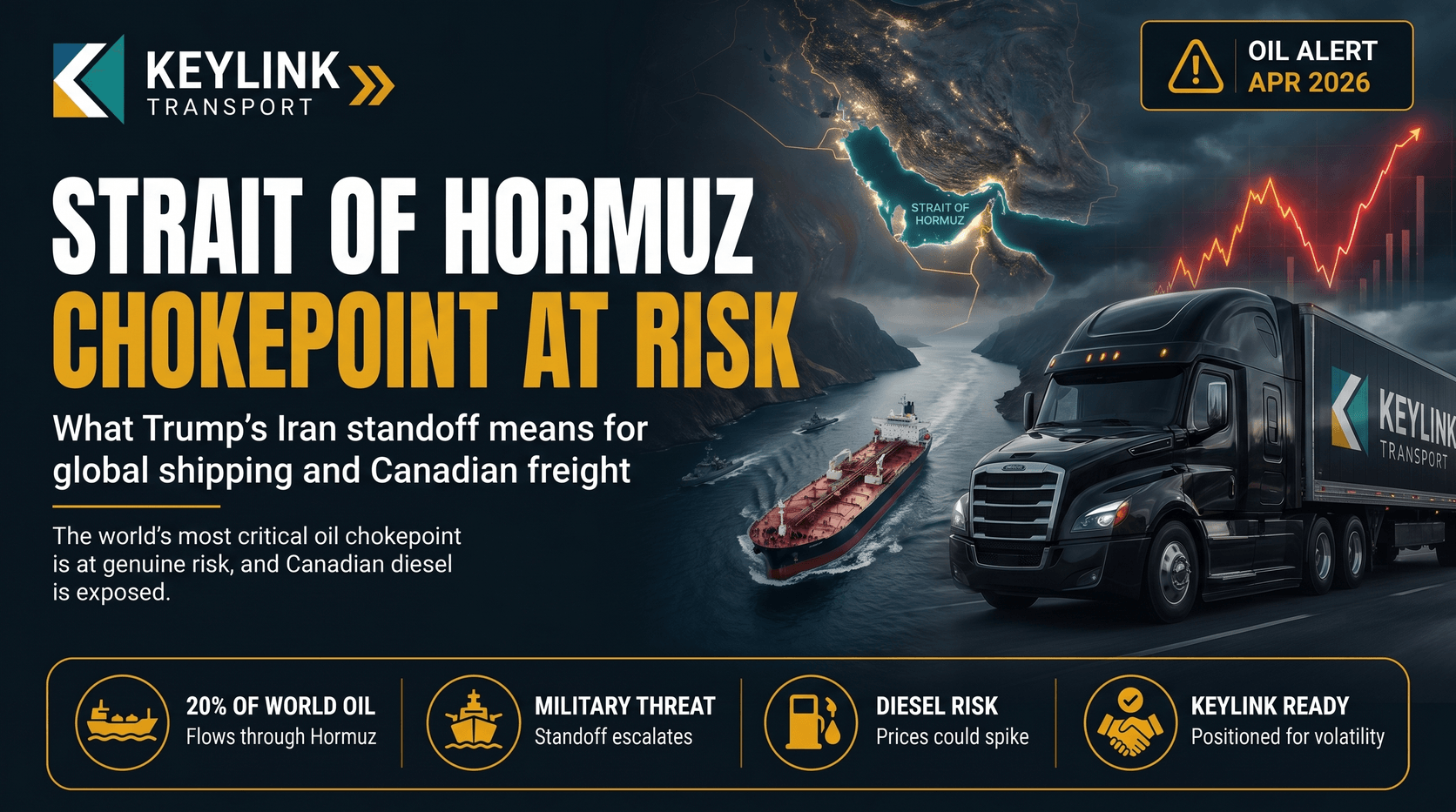
The Strait of Hormuz has never been closed in modern commercial history. But as of today, April 15, 2026, the conditions for a disruption are more credible than at any point in two decades. The Trump administration's maximum pressure sanctions campaign against Iran, relaunched in early 2025 and systematically intensified through 2026, has placed one of the planet's most critical shipping chokepoints at the center of global supply chain risk assessments.
For Canadian freight operators and shippers, the Strait of Hormuz can feel like a distant geopolitical abstraction. It is not. The strait handles approximately 21 million barrels of crude oil and petroleum products daily, representing roughly one-fifth of global petroleum consumption. When oil markets price in Hormuz risk, the price of diesel at BC and Alberta fuel stations moves within weeks. When that happens, freight economics change for every carrier, shipper, and supply chain manager in the country.
This article explains what the Hormuz situation actually is, why the current standoff between Washington and Tehran is genuinely dangerous to global shipping, and what Canadian freight operators should be doing right now to reduce their exposure to a potential disruption event.
What Is the Strait of Hormuz and Why Does It Matter?
Geography
The Strait of Hormuz is the narrow waterway connecting the Persian Gulf to the Gulf of Oman, which opens to the Arabian Sea. At its narrowest point, it measures approximately 33 kilometres across. Iran controls the strait's northern shore; the UAE and Oman share the southern coastline. The shipping lanes within the strait are narrow: the inbound lane for oil tankers is roughly 3 kilometres wide, and the outbound lane is similarly constrained.
Every major oil-producing state in the Persian Gulf, including Saudi Arabia, the UAE, Kuwait, Iraq, and Qatar, depends on the strait to export the majority of their oil and LNG production. Iran itself exports oil through the strait. The US Energy Information Administration (EIA) estimates that approximately 21 million barrels of crude oil and petroleum products transited the strait daily in 2024, making it the world's most critical maritime chokepoint by volume.
Why There Is No Easy Alternative
The alternatives to Hormuz are limited and insufficient for sustained volumes. Saudi Arabia operates the East-West Pipeline with a maximum capacity of approximately 5 million barrels per day, nowhere near sufficient to replace Hormuz flows. The UAE has the Abu Dhabi Crude Oil Pipeline (ADCOP) to the port of Fujairah, bypassing the strait with a capacity of 1.5 million barrels per day. Even combining these bypass routes, the vast majority of Persian Gulf oil exports would be stranded if the strait were closed. The International Energy Agency (IEA) maintains detailed analysis of Hormuz bypass capacity as part of its global oil security framework.
Trump's Maximum Pressure Campaign and the Military Threat
The Relaunched Sanctions Campaign
In February 2025, the Trump administration signed a new executive order reinstating and expanding the "maximum pressure" sanctions regime against Iran that had been partially lifted under the 2015 Joint Comprehensive Plan of Action (JCPOA) and its various negotiated continuations. The 2025 maximum pressure framework targets Iranian oil exports, financial institutions, and the Revolutionary Guard's economic interests with the stated objective of forcing Iran to accept a new, more comprehensive nuclear agreement.
The demands as presented publicly: complete cessation of uranium enrichment above civilian power plant thresholds, verifiable dismantlement of ballistic missile development programs, and a halt to material and financial support for regional proxy forces, including Houthi forces in Yemen, Hezbollah in Lebanon, and allied militias in Iraq. Iran's Supreme Leader publicly rejected the framing of these demands as preconditions, calling them an ultimatum incompatible with Iranian sovereignty.
Iran's Nuclear Escalation
Iran's response to renewed maximum pressure has followed the pattern established in 2019 and 2020: gradual nuclear escalation as leverage. By early 2026, Iran had enriched uranium stockpiles to 60% purity, approaching weapons-grade levels (90%). The International Atomic Energy Agency (IAEA) has repeatedly flagged reduced inspector access and accelerated enrichment activities in its quarterly reports. Multiple rounds of diplomatic talks, including an Oman channel, have stalled without substantive agreement.
The Military Dimension
The US has repositioned carrier strike group assets in the Arabian Sea and Persian Gulf region throughout 2025 and into 2026. Iran's Islamic Revolutionary Guard Corps (IRGC) naval forces have conducted exercises near the strait, including simulated blocking operations. IRGC commanders have stated publicly on multiple occasions that Iran would close the Strait of Hormuz if Iran faced military attack. The proximity of these red lines to current diplomatic conditions is what elevates Hormuz from background risk to active freight planning concern.
"A 30-day Hormuz closure would represent the largest single oil supply disruption in history, exceeding the combined impact of the 1973 Arab oil embargo and the 1990 Gulf War supply shock."
Historical Precedents: What Happened Last Time
The Tanker War (1984 to 1988)
During the Iran-Iraq War, both nations attacked commercial shipping in the Persian Gulf in a campaign known as the Tanker War. Between 1984 and 1988, approximately 451 commercial vessels were attacked. Insurance rates for Persian Gulf shipping spiked dramatically. Oil prices became volatile, though the strait itself was never fully closed. The US Navy's Operation Earnest Will escorted Kuwaiti tankers re-flagged under the American flag through the strait. The episode remains the most sustained threat to Hormuz transit in modern history and the clearest template for what partial disruption looks like.
The 2012 Sanctions Escalation
When the Obama administration and European Union imposed major oil sanctions on Iran in 2012, Iran's parliament and military commanders publicly threatened to close the Strait of Hormuz if Iranian oil exports were banned. The threats caused oil prices to spike toward $120 per barrel on global markets. The strait was never closed, but the episode demonstrated that credible threat language alone, with no physical action, moves oil markets materially.
The 2019 Gulf Attacks
In June 2019, two oil tankers were attacked in the Gulf of Oman, near the strait's exit. The US attributed the attacks to Iran. The incidents caused an immediate 4% spike in Brent crude oil prices. In September 2019, drone and cruise missile strikes on Saudi Aramco's Abqaiq processing facility, attributed to Iran by US and Saudi intelligence, temporarily removed 5.7 million barrels per day of Saudi oil output from markets and caused the single largest one-day spike in oil prices since 1991.
How a Hormuz Disruption Would Hit Canadian Diesel Prices
Canada Is Not Insulated
A common misconception among Canadian freight operators is that Canada's domestic oil production provides insulation from Middle Eastern supply shocks. The reality is more complex. Canada is a significant oil producer, but oil is globally priced. Canadian crude (primarily Western Canadian Select, a discounted blend) trades at a discount to West Texas Intermediate (WTI) and Brent benchmarks, but a shock to global supply prices WTI and Brent upward, and Canadian crude prices follow, including at the pump.
Diesel prices in BC and Alberta are particularly sensitive to global crude benchmarks because refined product pricing, including the diesel that powers Canadian truck fleets, tracks these benchmarks closely. Natural Resources Canada's fuel price monitoring confirms the tight historical correlation between global crude benchmarks and Canadian retail diesel prices.
The Price Impact Model
A credible Hormuz closure scenario: analysts at the IEA and the EIA have modelled partial and full Hormuz disruption scenarios that suggest a 30-day closure would remove approximately 15 to 21 million barrels per day from global supply, a shock with no modern precedent. Price impacts in these models range from $40 to $80 per barrel added to WTI prices, depending on the speed of strategic reserve releases and demand destruction.
At a $60 per barrel WTI increase (from approximately $75 current to $135 per barrel), historical diesel refining crack spreads suggest Canadian retail diesel would increase by approximately $0.40 to $0.55 per litre. At current BC pump prices near $1.80 per litre, this represents a 22 to 31% single-event price increase.
Fleet Economics at $2.35 Per Litre Diesel
A modern long-haul transport truck consumes approximately 35 to 40 litres per 100 kilometres. For a truck running 12,000 to 15,000 kilometres per month on BC and Alberta corridors, a $0.50/L diesel increase adds approximately $2,100 to $3,000 in monthly fuel cost per truck. For a fleet of 10 trucks operating on these lanes, that is $21,000 to $30,000 in additional monthly operating costs, with no corresponding revenue increase unless fuel surcharge provisions are activated.
The Downstream Effect on Canadian Supply Chains
Everything That Moves by Truck Costs More
The immediate consequence of a major fuel price increase is straightforward: freight rates rise because carriers must recover fuel costs or exit unprofitable lanes. Fuel surcharges that have been negotiated at current diesel price levels will not cover the gap; carriers will need to either renegotiate fuel surcharge structures or absorb losses. Shippers without strong contractual fuel surcharge provisions will face ad hoc rate increases that can arrive with days of notice.
Container Shipping from Asia
Canada's import supply chains, particularly goods flowing from Asian manufacturers through the Port of Vancouver, would face a second layer of disruption. While most Asia-Canada container routes use the Pacific lane (not Hormuz), the oil price shock from a Hormuz closure would increase vessel fuel costs globally, translating into container rate increases across all trade lanes including the transpacific. Asia-Pacific shipping is already operating at tightly managed capacity; a cost shock without corresponding demand reduction historically produces immediate rate spikes.
BC and Alberta Agricultural Supply Chains
Agricultural producers in BC and Alberta depend heavily on diesel-intensive operations: field work, grain transport, refrigerated produce shipping, and livestock transport all carry significant fuel cost exposure. A major diesel price increase at harvest or planting season would compress agricultural margins and create downstream pressure on food supply chain economics. For FTL carriers serving agricultural shippers on BC-Alberta corridors, this translates into reduced shipper budget capacity and potential load volume reductions on price-sensitive commodity lanes.
What Carriers and Shippers Can Do Now
Review and Strengthen Fuel Surcharge Contract Language
Every freight contract should include a clearly defined fuel surcharge mechanism tied to a published price index, such as the Natural Resources Canada weekly diesel price survey. Contracts with fixed all-in rates carry no fuel adjustment mechanism and expose either carriers or shippers to the full cost of price shocks. If you are currently operating under fixed-rate agreements, renegotiate before a disruption event makes the conversation adversarial.
Build Inventory Buffers on Long-Lead Import Items
For shippers importing goods through transpacific lanes, a Hormuz-driven shipping cost shock will translate into lead time extensions and rate increases within weeks of the initiating event. Shippers who carry two to three weeks of additional safety stock on high-turnover import categories will absorb a disruption event with significantly less operational damage than those running lean just-in-time inventories.
Monitor IEA and EIA Price Forecasts Actively
The IEA's monthly Oil Market Report and the EIA's Weekly Petroleum Status Report are authoritative, freely available sources on global oil supply and price conditions. Supply chain managers who monitor these publications can identify deteriorating conditions weeks before they fully transmit to Canadian diesel prices, providing a planning window that reactive operators will not have.
Lock In Contract Freight Rates Before a Disruption Event
Spot rate markets respond immediately to fuel cost shocks. Shippers who have locked in contractual freight rates for their core lanes at pre-disruption levels have a meaningful cost advantage during a price volatility event. Carriers with full fleets offering contractual capacity are motivated to lock in rates with reliable shippers before market conditions make spot rates more attractive. This alignment creates a window for mutually beneficial rate agreements right now, before the situation evolves further.
Diversify Your Carrier Relationships
A fuel price shock will stress smaller carriers disproportionately. Carriers with thin margins and no fuel surcharge cushion may exit unprofitable lanes quickly during a disruption event. Shippers who depend on a single carrier for a critical lane and whose carrier lacks financial resilience face both a rate shock and a capacity loss simultaneously. Building relationships with two or three qualified carriers on your highest-volume lanes provides a hedge against capacity withdrawal under stress conditions.
How Keylink Positions for Fuel Volatility
At Keylink Transport, our rate structure is designed to operate transparently through fuel price cycles. We believe shippers deserve to understand exactly how fuel costs flow through to freight rates, and we structure our agreements accordingly.
- Published fuel surcharge structure: Our fuel surcharge mechanism is tied to the Natural Resources Canada weekly diesel price index for BC. Surcharge adjustments are calculated transparently and applied consistently, so shippers can forecast freight costs with precision even as fuel prices move.
- Modern, fuel-efficient fleet: We operate late-model trucks with current engine technology, which delivers measurably better fuel economy than aging equipment. This is not just a sustainability position: it directly reduces per-kilometre fuel cost and our exposure to fuel price shock relative to operators running older iron.
- Contractual capacity commitment: We do not chase spot rates at the expense of committed customers. When fuel prices spike and spot markets become attractive, our contract clients retain their agreed capacity at agreed rate structures, adjusted only through the fuel surcharge mechanism.
- Operational transparency: If fuel price conditions change materially, we communicate proactively with our clients rather than presenting revised invoices without context. You will hear from us before you see an unexpected charge.
If the current geopolitical environment has prompted you to review your freight contracts and carrier relationships for fuel price resilience, we welcome that conversation. Review our freight services page or contact us directly. We also recommend reviewing our analysis of supply chain disruption strategies for Canadian shippers for the broader context of building freight resilience.
Keylink Transport offers transparent, contractual FTL capacity on western Canada and cross-border lanes. Let's structure a rate agreement that works through fuel volatility.
Talk to Our Team →The Bottom Line
The Strait of Hormuz has not been closed in modern history, and there remains a reasonable probability that the current US-Iran standoff will resolve without a physical disruption to shipping. But the conditions for a disruption are more credible today than at any point since the 2019 Gulf attacks, and the potential magnitude of a Hormuz event is larger than any other single supply chain shock that Canadian freight operators face.
Prudent supply chain management does not require predicting that a disruption will happen. It requires acknowledging that it could happen, understanding the transmission mechanism from a Persian Gulf oil shock to a Canadian diesel price spike, and putting the contractual and operational structures in place that limit your exposure if it does.
The freight operators and shippers reading this who have already reviewed their fuel surcharge provisions, locked in contractual capacity, and built inventory buffers will thank themselves later. The ones who wait for the event to act will spend the disruption period trying to solve an entirely preventable problem under time pressure.