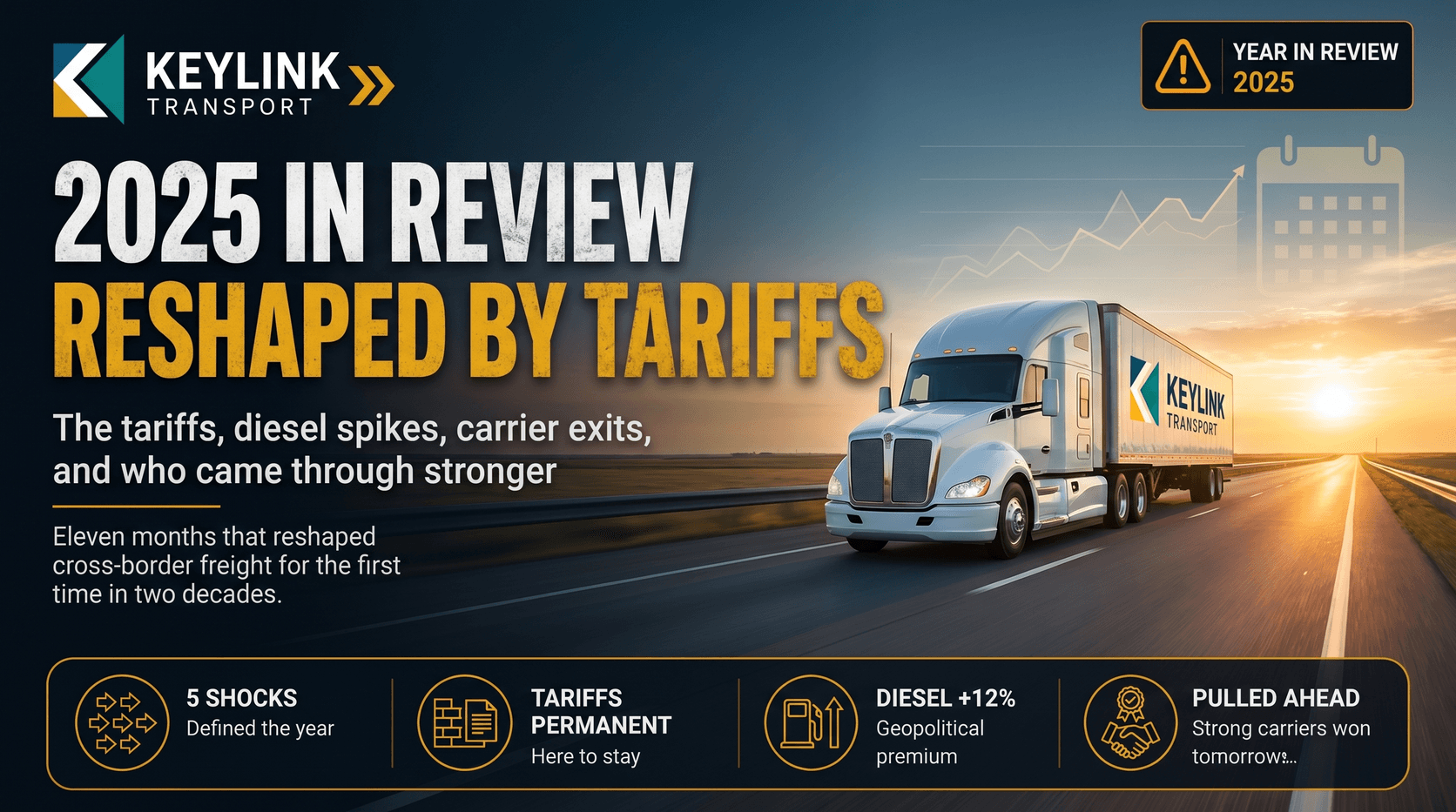
2025 will be remembered as the year cross-border Canadian freight stopped being a logistics business and started being a policy business. The 25% IEEPA tariff in March, the steel and aluminum duty in March, the Liberation Day reciprocal tariffs in April, the Iran-Israel war in June, the Carney election in April, and the US shutdown in October each rewrote a piece of how trucks move between Canada and the United States.
The carriers and shippers who treated each shock as the new floor, not the temporary ceiling, finished the year stronger than they started it. Here is the recap of how the year unfolded, what stuck, and what carriers should be doing as we close out the books.
The Five Shocks That Defined the Year
The year had a recognizable rhythm. Every six to eight weeks, a new event reset the operating environment for cross-border carriers: February 1, the IEEPA tariff signing; March 4, the tariff effective date; April 2, Liberation Day; April 28, the Carney election; June 13-24, the Iran-Israel war; October 1, the US shutdown; November 13, the Senate-passed deal that ended the shutdown.
Each event was processed in two phases: a 48-hour scramble at the cross-border carrier level, followed by 4-6 weeks of contract renegotiation, surcharge adjustment, and lane reconfiguration. By Q4, the cumulative effect was a Canadian freight market that operates at a higher per-mile cost, with tighter capacity, on shorter contract horizons, with stronger CUSMA documentation discipline.
Tariffs: From Threat to Permanent Cost
The tariff regime that landed on March 4 is still in force on December 9. CBC's year-end coverage of the trade fight noted that exemptions, carve-outs and reciprocal layers have shifted what counts as tariffed, but the structural reality has held: Canadian goods that don't meet CUSMA rules of origin face a 25% duty, steel and aluminum face an additional 25% Section 232 tariff, and energy faces 10%.
The carve-out for CUSMA-compliant goods, originally set to expire April 2, has been extended twice. Bloomberg reported in late November that the current carve-out runs through March 31, 2026, with no commitment beyond that date.
Politics: From Trudeau to Carney
The political year began with Trudeau's resignation on January 6 and ended with a Liberal minority under Carney that has held parliamentary support through three confidence tests. The transition removed Canada's pre-existing negotiating relationships with Trump's economic team and replaced them with a technocrat prime minister whose central commitment is to negotiate as an equal.
"This was the year that confirmed what every carrier in Canada has felt for two years: cross-border freight is now a policy business first, a logistics business second. The shippers who haven't internalized that yet will spend 2026 absorbing what 2025 already taught the rest of us." - Canadian fleet operator, Q4 2025
The CUSMA review track is now formally calendared for July 2026, and the political conditions on both sides of the border will dominate freight conditions through that window.
Geopolitics: Iran, Hormuz, and a 12% Diesel Premium
The 12-day Iran-Israel war in June pushed Canadian diesel from $1.62 to a peak of $1.94 per litre. Even with a ceasefire, Q4 diesel has settled around $1.78, a permanent 10% premium above pre-war baselines. Natural Resources Canada's weekly diesel benchmarks show no return to early-2024 pricing.
The Hormuz risk premium is now structural. Carriers running fixed surcharge tables are absorbing the difference. Carriers on weekly index-linked surcharges are passing it through transparently. The gap is the single biggest contract-year operating advantage in cross-border freight today.
Operations: The Carriers That Pulled Ahead
Three operational themes separated outperformers from the rest. Documentation discipline: carriers who built CUSMA origin certification into every dispatch process avoided the 25% duty on the bulk of their lanes. Surcharge transparency: carriers who replaced fixed tables with NRCan-linked weekly indices kept margins stable through the diesel spike. Communication cadence: carriers who proactively contacted shippers ahead of policy events, rather than reacting to invoice questions, retained customer relationships through the year.
What 2025 Set Up for 2026
2026 begins with three live deadlines. March 31: the current CUSMA carve-out expires unless extended. July 1: the formal CUSMA Article 34.7 joint review begins, with a decision required on whether to extend the agreement another 16 years. December 31: the FY2026 US continuing resolution that ended the October shutdown expires, raising the possibility of another shutdown event.
Each of these is a known trigger that will reshape cross-border freight in the same way the 2025 shocks did. The carriers and shippers who plan against this calendar, rather than reacting to it, will set the pace for 2026.
The Bottom Line
2025 didn't break Canadian trucking. It rewired it. Tariffs are the new floor, not the new emergency. Surcharges are weekly, not quarterly. Cross-border documentation is a competency, not a back-office function. Driver retention, customer communication, and carrier consolidation will keep mattering in 2026 the way they mattered in 2025.
At Keylink, we ran every cross-border lane through this year with weekly NRCan surcharges, full CUSMA documentation, and dispatch that picked up the phone. We finish 2025 stronger than we started it because the year rewarded those choices. We will keep making them in 2026.
Thank you to every shipper and driver who moved freight with us this year. The trucks have to keep moving. Ours will.