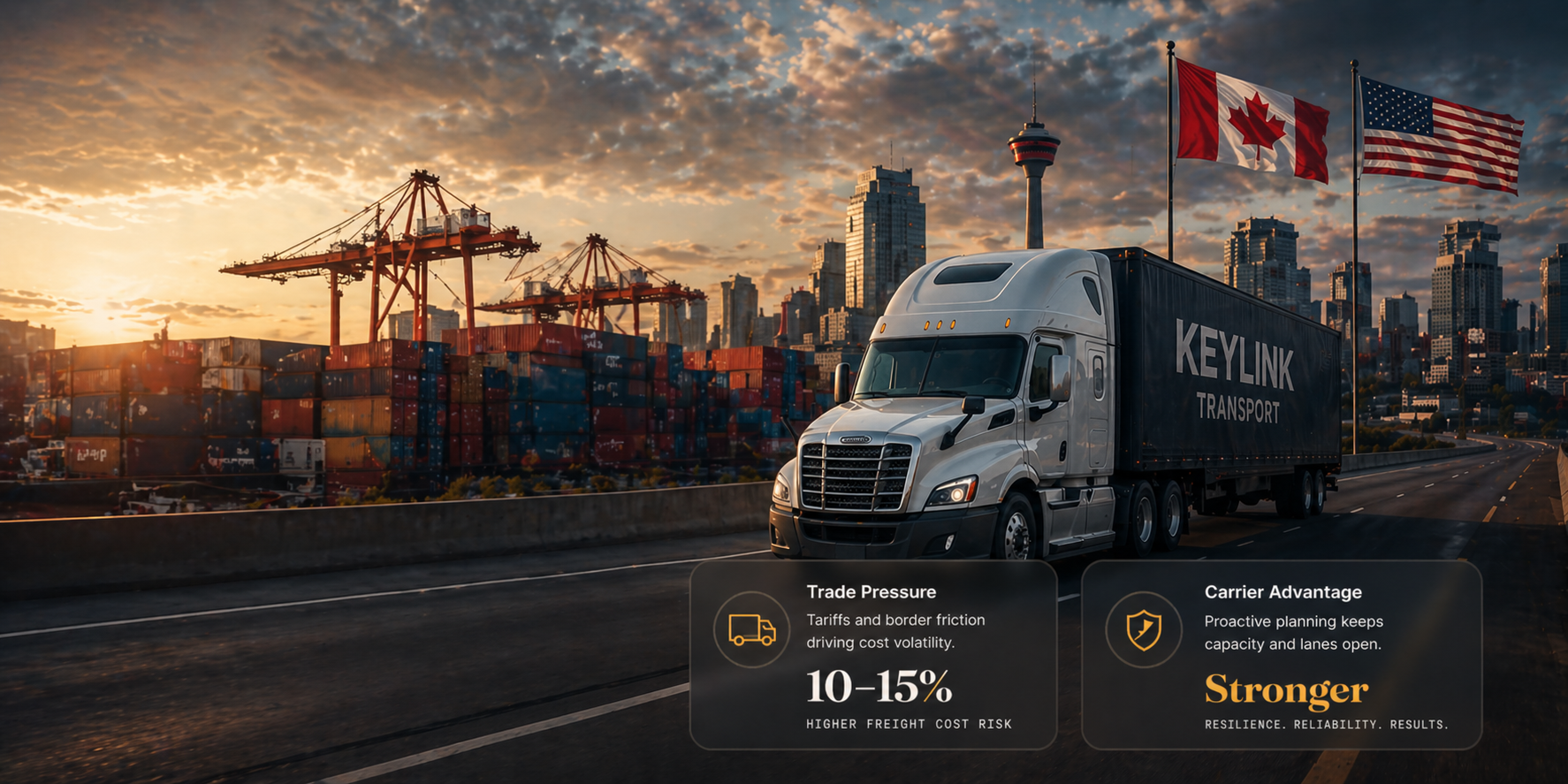
The freight recession that began in mid-2022 is no longer a temporary market correction. It is the longest sustained downturn in North American trucking in over a decade, and it is reshaping the Canadian carrier landscape in ways that will take years to fully reverse. Carriers that survived the pandemic boom by expanding aggressively are now facing the consequences of that expansion in a market that has fundamentally shifted beneath them.
The numbers are stark. In the first half of 2024 alone, the Federal Motor Carrier Safety Administration (FMCSA) recorded a net contraction of nearly 10,000 motor carriers across North America. The previous year saw 88,000 trucking authorities revoked. In Canada, the collapse of Pride Group Holdings, one of the country's largest trucking enterprises, has become the defining casualty of this downturn, a signal that no carrier is too large to fail when market fundamentals turn against you.
This article examines the full scope of the freight recession, what caused it, who is being hit hardest, and what Canadian carriers and shippers can do to position themselves for survival and eventual recovery.
What Happened: Two Years of Freight Recession
To understand the current crisis, you need to understand what came before it. Between 2020 and early 2022, the North American trucking industry experienced one of the most dramatic boom cycles in its history. The pandemic disrupted global supply chains, created massive consumer demand for delivered goods, and shifted spending from services to physical products. Freight volumes surged. Spot rates exploded to record levels. Carriers that could put a truck on the road were printing money.
The boom incentivized rapid expansion. Thousands of new trucking authorities were granted. Owner-operators purchased trucks at inflated prices, often financing them at high interest rates. Larger carriers expanded fleets aggressively, adding equipment and drivers to capture as much of the elevated rate environment as possible. The logic was straightforward: rates were high, loads were plentiful, and the money was flowing.
Then, in mid-2022, the correction arrived. Consumer spending patterns shifted back toward services. Freight volumes plateaued and then declined. The supply of available trucks, swollen by two years of aggressive expansion, vastly outstripped demand. Spot rates collapsed. What had been the most profitable market in a generation became one of the most punishing, and it has stayed that way for over two years.
"The freight recession has now lasted longer than the COVID bull market that preceded it. The carriers who expanded fastest during the boom are the ones bleeding out the fastest in the downturn."
Pride Group Holdings: Canada's Largest Trucking Bankruptcy
On March 27, 2024, Pride Group Holdings filed for bankruptcy protection under the Companies' Creditors Arrangement Act (CCAA) in Ontario. The Mississauga-based company operated one of the largest private trucking fleets in Canada, with approximately 20,000 tractor-trailers spread across 50 locations. The filing revealed $637 million in debt and directly affected 669 employees.
Pride Group's collapse did not happen overnight. The company had expanded aggressively during the pandemic boom, acquiring equipment and growing its fleet to capture elevated freight rates. When the market turned, the company found itself carrying debt loads that could not be serviced at post-boom revenue levels. FreightWaves reported that Pride Group's bankruptcy filing underscored the broader impact of the trucking downturn on carriers that had leveraged up during the good times.
What Pride Group's Failure Tells Us
Pride Group's bankruptcy is significant not because it is unique, but because it represents the extreme end of a pattern playing out across the industry. The core mistake, expanding capacity and taking on debt during a cyclical peak, is the same mistake that has destroyed smaller carriers by the thousands. Pride Group had the scale to absorb losses longer than a five-truck operation, but no amount of scale protects a carrier from structural overcapacity combined with unsustainable debt. The lesson is clear: in a freight recession, the size of your fleet matters less than the strength of your balance sheet.
The Carnage by the Numbers
Pride Group is the largest Canadian casualty, but the broader industry contraction is staggering. According to FMCSA data, the first half of 2024 saw a net loss of nearly 10,000 motor carriers across North America. That figure represents carriers whose operating authorities were revoked, suspended, or voluntarily surrendered, minus the number of new authorities granted during the same period. The industry is shrinking, and it is shrinking fast.
In 2023, the situation was even more severe in raw terms: approximately 88,000 trucking authorities were revoked across North America. While authority revocations do not always correspond one-to-one with business closures (some carriers hold multiple authorities, and some revocations are administrative), the scale of the contraction is unmistakable. The industry entered 2024 with significantly fewer active carriers than it had 18 months earlier, and the exits have continued throughout the year.
Spot Rates Below Operating Costs
The mechanism driving these exits is straightforward: spot rates have collapsed below operating costs for many small and midsize carriers. During the boom, dry van spot rates on key North American lanes exceeded $3.00 per mile. By early 2024, those same lanes were trading below $2.00 per mile, and in some cases below $1.50. For owner-operators carrying truck payments of $2,500 to $3,500 per month, insurance costs of $1,200 or more per month, and fuel costs that remain elevated despite crude price declines, the math simply does not work at these rate levels.
The carriers exiting the market are overwhelmingly small operations: one-truck owner-operators and small fleets of fewer than ten trucks. These businesses have the least pricing power, the thinnest margins, and the fewest options for diversifying revenue. When spot rates drop below the cost of operating a truck, these carriers either park equipment, surrender their authority, or default on their loans.
Root Causes: How the Industry Got Here
Oversupply: The Hangover from the Pandemic Boom
The single largest driver of the freight recession is oversupply. During 2020 and 2021, the combination of record freight demand and record spot rates drew tens of thousands of new entrants into the trucking industry. New authorities were granted at unprecedented rates. Existing carriers expanded fleets. Equipment manufacturers ramped production. The result was a dramatic increase in available trucking capacity that persisted even as freight demand normalized in 2022.
The problem is that trucking capacity is much easier to add than it is to remove. A new carrier can obtain operating authority and lease a truck in weeks. Removing that capacity from the market, through business failure, equipment repossession, or voluntary exit, takes months or years. The oversupply overhang from the pandemic boom has taken over two years to begin correcting, and the market is still working through excess capacity.
Decreased Freight Demand
While the supply side flooded the market with trucks, the demand side was simultaneously softening. Consumer spending shifted back toward services, restaurants, travel, and entertainment as pandemic restrictions ended. Inventory levels, which had been critically low during the supply chain crisis, were rebuilt and in many categories overbuilt. Retailers and manufacturers found themselves with excess inventory, reducing their need for inbound freight. The combination of too many trucks chasing fewer loads created the rate collapse that defines this recession.
Rising Diesel Costs
Diesel prices, though they have retreated from their 2022 peaks, remain significantly elevated relative to pre-pandemic levels. For Canadian carriers, diesel costs are the single largest variable expense, typically representing 25 to 35% of total operating costs. Carriers operating at razor-thin margins or below breakeven on spot rates are particularly exposed to fuel cost fluctuations, which can push an already unprofitable load into outright loss territory.
High Interest Rates
The Bank of Canada and the US Federal Reserve raised interest rates aggressively through 2022 and 2023 to combat inflation. For trucking companies carrying equipment financing, higher interest rates mean higher monthly payments on trucks and trailers purchased during the boom. A carrier that financed a truck at 4% in 2021 and needs to refinance or acquire additional equipment at 8% in 2024 faces a material increase in fixed costs. For carriers already struggling with depressed revenues, higher financing costs can be the difference between survival and bankruptcy.
The Canadian Trucking Landscape Under Pressure
Canada's trucking industry has its own structural characteristics that shape how the freight recession is experienced domestically. According to the Canadian Trucking Alliance (CTA), the Canadian trucking industry comprises approximately 135,000 businesses. Two-thirds of these businesses are classified as small or midsize operations, meaning they run fewer than 20 trucks. Many are single-truck owner-operators or family-run enterprises with fewer than five units.
This structure makes the Canadian trucking industry particularly vulnerable to a sustained freight recession. Small carriers lack the diversified revenue streams, contractual customer bases, and financial reserves that buffer larger operations during downturns. They are disproportionately dependent on spot market freight, which is precisely the market segment where rates have collapsed the most. They carry higher per-unit fixed costs because they cannot spread overhead across a large fleet. And they have less negotiating power with shippers, fuel suppliers, and equipment lenders.
Cross-Border Complexity
Canadian carriers that operate cross-border freight between Canada and the United States face additional challenges. Currency fluctuations between the Canadian and US dollar affect revenue and cost structures for carriers billing in one currency and paying expenses in another. Regulatory compliance costs, including FMCSA requirements, C-TPAT participation, and customs brokerage, add fixed overhead that does not scale down during a downturn. And cross-border lanes, while typically higher-rated than domestic Canadian lanes, have seen rate compression as well, narrowing the premium that traditionally made cross-border work attractive.
Regional Disparities
The freight recession has not hit all Canadian regions equally. Western Canada, particularly Alberta and British Columbia, has experienced pressure from softening resource sector freight demand alongside the broader consumer freight downturn. Ontario, as the hub of Canada's manufacturing and distribution economy, has seen significant contraction in shorter-haul regional freight as inventory destocking reduced load volumes. The Maritimes and Prairie provinces, with smaller but more concentrated trucking markets, have seen individual carrier failures create outsized disruptions in local freight capacity.
The LMIA Paradox: Importing Drivers Into a Recession
One of the most striking contradictions of the current freight recession is the Canadian federal government's continued issuance of Labour Market Impact Assessments (LMIAs) for truck drivers at record levels. LMIAs allow Canadian employers to hire temporary foreign workers when domestic workers are not available for specific positions. Throughout 2023 and into 2024, the federal government approved a record number of LMIAs for truck driver positions, even as thousands of existing carriers were going out of business and experienced drivers were being laid off or leaving the industry.
The disconnect reflects a structural mismatch between immigration policy timelines and freight market cycles. LMIA processing takes months. Applications filed during the tail end of the boom, when driver shortages were genuine and acute, were being approved and acted upon well into the recession. The result is an influx of new drivers entering an oversupplied market, which adds further downward pressure on wages and rates at precisely the moment when the industry needs capacity to exit, not enter.
"The federal government issued record LMIAs for truck drivers throughout 2023 and 2024, even as 88,000 trucking authorities were being revoked and carriers were going bankrupt by the thousands. The policy lag is creating a labour market collision."
For established Canadian carriers, the LMIA paradox creates a dual pressure: rates are depressed because of oversupply, and the cost advantage of experienced, efficient operations is diluted by an influx of new entrants willing to work for lower rates. This is not a criticism of the immigrant drivers themselves, who are responding rationally to available opportunities. It is a structural policy failure that exacerbates an already painful market correction.
Survival Strategies for Canadian Carriers
The freight recession will end. Cycles are inherent to the trucking industry, and the current wave of capacity exits is gradually bringing supply and demand closer to equilibrium. But "eventually" is not a strategy. Carriers that want to be operating when the recovery arrives need to act deliberately right now. Here are the strategies that are separating survivors from casualties.
Ruthless Cost Control
Every line item in your operating budget needs to be scrutinized. Fuel efficiency programs, route optimization, preventive maintenance scheduling that avoids costly breakdowns, and renegotiation of insurance premiums are all available levers. Carriers that operate at 10% lower cost per mile than their competitors can survive rate environments that destroy less efficient operations. This is not the time for discretionary spending on equipment upgrades, facility expansions, or nice-to-have technology. Focus on the fundamentals that keep per-mile costs as low as physically possible.
Revenue Diversification
Carriers that depend entirely on spot market freight are the most exposed to rate volatility. Building a mix of contractual and spot revenue, ideally with 60 to 70% of loads under contract, provides a baseline of predictable income that buffers against spot rate fluctuations. Pursuing dedicated freight arrangements, where a carrier commits capacity to a single shipper for a defined period, can provide revenue stability even at rates below peak spot levels. The key is predictability: knowing what your trucks will earn next month matters more than chasing the highest-paying load today.
Fuel Surcharge Renegotiation
Many carriers entered into freight contracts during the boom with fuel surcharge provisions calibrated to a different diesel price environment. As fuel costs have fluctuated, these provisions may no longer accurately capture actual fuel expenses. Carriers should review every active contract's fuel surcharge formula, ensure it is tied to a transparent published index such as the Natural Resources Canada diesel price survey, and renegotiate provisions that are not keeping pace with actual costs. A fuel surcharge that under-recovers by even $0.05 per litre compounds across thousands of kilometres into significant margin erosion.
Right-Size Your Fleet
One of the hardest decisions in a downturn is voluntarily reducing capacity. Carriers that expanded during the boom may need to park trucks, return leased equipment, or sell assets at a loss to bring their fleet size in line with current revenue capacity. Running trucks that are not generating revenue above their cost of operation is bleeding cash. Every unprofitable truck in your fleet is subsidized by the profitable ones, dragging down overall margins. It is better to operate eight trucks profitably than twelve trucks at a loss.
Preserve Cash and Manage Debt Aggressively
Cash is survival in a downturn. Carriers should build and protect cash reserves, even if it means foregoing opportunities that require capital investment. Debt should be managed actively: refinance where possible to reduce monthly payments, negotiate payment deferrals with equipment lenders, and avoid taking on any new debt that is not absolutely essential for maintaining current operations. The carriers that survive recessions are not the ones with the most trucks. They are the ones with the most cash and the least debt when the bottom arrives.
Strengthen Shipper Relationships
In a rate-depressed market, the temptation for shippers is to chase the lowest rate available. Carriers that differentiate on service reliability, communication quality, and operational consistency retain shippers even when cheaper alternatives exist. The carriers that will emerge strongest from this recession are the ones whose shippers view them as partners rather than interchangeable vendors. Invest in service quality, respond to issues proactively, and demonstrate the value you deliver beyond the base rate. When rates recover, those loyal shipper relationships become your most valuable asset.
How Keylink Is Navigating the Downturn
At Keylink Transport, we have chosen to navigate the freight recession with discipline rather than panic. Our approach is built on the same principles we recommend to the broader industry: cost control, revenue diversification, and a relentless focus on service quality that keeps our shippers coming back.
- Conservative financial management: We did not over-leverage during the boom, and we are not scrambling to service unsustainable debt during the downturn. Our balance sheet reflects a carrier that plans for cycles, not one that bets on permanent prosperity.
- Contractual revenue focus: The majority of our freight moves under contractual arrangements with established shippers. This gives us revenue predictability that pure spot-market carriers cannot match, and it gives our shippers capacity certainty that is increasingly valuable as weaker carriers exit the market.
- Transparent rate structures: Our fuel surcharge mechanisms are tied to published indices, and our rate structures are designed to be fair to both carrier and shipper across different market conditions. We do not surprise our customers with unexplained rate increases, and we do not undercut the market with unsustainable rates that will force us to renegotiate later.
- Operational efficiency: We run a modern, fuel-efficient fleet and optimize our routes to minimize deadhead miles. These are not luxuries; they are survival basics in a market where every cent per mile matters.
The freight recession is painful, and it has claimed many good operators who made reasonable decisions that turned out to be wrong in hindsight. But recessions also create opportunities for well-positioned carriers. As weaker competitors exit, capacity tightens. As capacity tightens, rates recover. The carriers that are still operating when that recovery arrives will be in a stronger competitive position than they were before the downturn began.
For shippers evaluating their carrier relationships, the recession offers a different kind of opportunity: the chance to identify and commit to carriers that will still be here in two years. Working with a carrier that might offer a slightly lower rate today but lacks the financial stability to honor that commitment next quarter is a false economy. The real cost of carrier failure to a shipper, scrambling for replacement capacity, disrupted delivery schedules, damaged customer relationships, far exceeds any savings from chasing the lowest available spot rate.
Keylink Transport offers reliable, contractual FTL capacity on western Canada and cross-border lanes. Work with a carrier built to last through market cycles.
Talk to Our Team →The Bottom Line
The freight recession that began in mid-2022 has reshaped the North American trucking landscape. Nearly 10,000 motor carriers exited the industry in the first half of 2024 alone. The collapse of Pride Group Holdings, with its $637 million in debt and 20,000 tractor-trailers, stands as a cautionary tale about the dangers of overleveraging during a cyclical boom. And the continued wave of small carrier failures across Canada and the United States confirms that the correction is not over.
But freight recessions end. They always have. The pandemic-driven oversupply is being absorbed through the painful but necessary process of capacity exit. The Canadian Trucking Alliance has noted signs of improvement, though the outlook remains soft. When the recovery arrives, the carriers that survived will operate in a less crowded, better-balanced market.
The question for every Canadian carrier right now is simple: will you be one of the survivors? The answer depends not on the market, which is the same for everyone, but on the decisions you make today about cost discipline, revenue diversification, debt management, and customer relationships. The carriers that treat this recession as a test of operational excellence, rather than a waiting game, will be the ones still running trucks when the freight market turns.