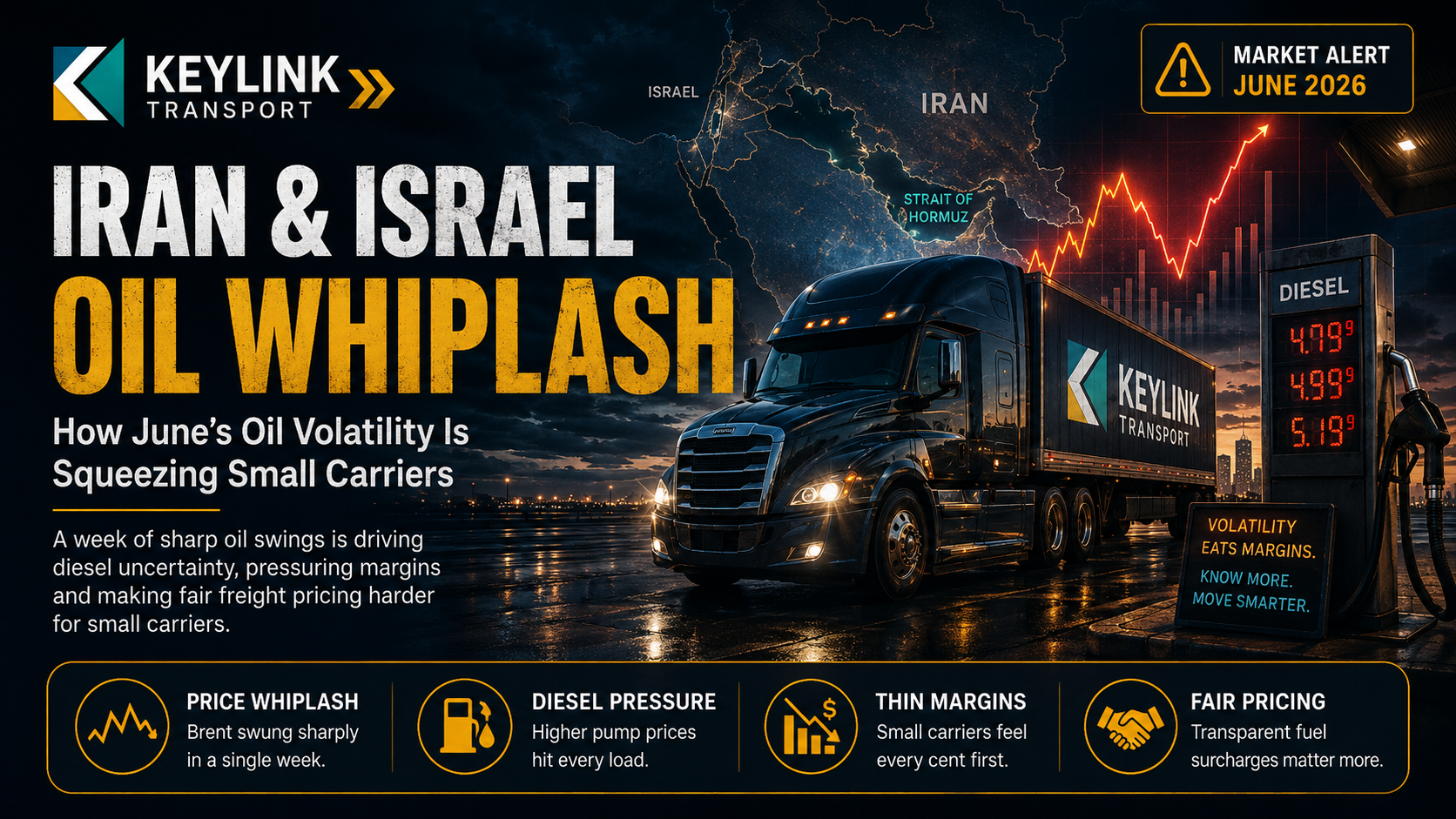
The Middle East is back on the front page, and the fuel desk knows it before the news does. On June 8 Iran fired missiles at Israel again, the first such exchange since the April ceasefire, in retaliation for Israel's campaign in Lebanon. Within hours Tehran told CNBC its military operations were over, but warned it would start again if Jerusalem struck Lebanon. Oil did exactly what oil does when the Strait of Hormuz is in the headlines: it spiked, then sagged, then climbed again, all inside a single week.
For a large fleet with a hedging desk and a treasury team, that is a line item. For a small carrier, it is the whole month. The price of a litre of diesel is the single largest controllable cost on most owner-operator and small-fleet income statements, and right now that price is not just high, it is unpredictable from one week to the next. This piece looks at what the renewed conflict has done to fuel, how today compares to a year ago, and the specific things responsible small carriers, Keylink included, are doing to keep customer pricing fair through the chaos.
What Just Happened This Week
The short version is that the April ceasefire did not hold. After Israel moved against Hezbollah positions in Lebanon, Iran responded with a missile barrage on June 8, the first direct strike on Israel in roughly seven weeks. Markets had been pricing in a fragile but functioning truce. The strike reminded everyone how thin that truce was.
The oil reaction tells the whole story. Earlier in the week, as President Trump signalled he was not committed to extending the 60-day ceasefire framework, Brent jumped more than 4% to above $97. Then Iran's foreign ministry said operations were over, and prices eased back toward the mid-$90s, with Brent around $94 and U.S. West Texas Intermediate near $91.60 by June 8. The near-closure of the Strait of Hormuz, where roughly a fifth of the world's seaborne oil passes, kept a floor under prices the entire time. This is the continuation of a story we have been tracking since the spring, from the Iran-US peace talks in Pakistan through the May oil shock that pushed Canadian diesel past $2.20.
"A megafleet hedges the price. A small carrier lives it. When Brent moves seven percent in a week, the owner-operator feels every cent of it at the pump on Friday."
Why the Swing Hurts More Than the Price
Most coverage focuses on the headline number, on whether diesel is $2.10 or $2.25. For a small carrier, the level matters less than the speed. A high but stable price can be quoted, surcharged, and built into a rate. A price that lurches up and down inside a single billing cycle cannot.
Here is the mechanism. A small carrier quotes a customer a rate on Monday based on the diesel price it knows. The truck runs the lane Wednesday. The fuel that powers that run was bought at Thursday's pump price, after a Tuesday missile headline pushed it up nine cents. The customer agreed to Monday's number. The carrier absorbed Thursday's. Multiply that gap across every load in a volatile week and a thin margin becomes a negative one. The chart below shows exactly the kind of intra-week movement that does the damage.
Large carriers blunt this with fuel hedging, fleet fuel cards with negotiated discounts, and the balance-sheet cushion to ride out a bad month. A three-truck operation has none of those tools. That is why volatility, more than any single high number, is what pushes small carriers either into losses or into the corner of cutting service to survive. The carriers worth shipping with are the ones that found a third option.
Diesel Now vs a Year Ago
To understand how compressed small-carrier margins have become, it helps to look back twelve months. In June 2025 the national average diesel price in Canada sat around $1.31 a litre. By late May 2026 it had climbed to roughly $2.17, with the June flare-up keeping it elevated. That is a 66% year-over-year increase, and it did not arrive gradually. It came in waves, each one tied to a Middle East headline. The chart below puts the two years side by side, month by month.
The visual makes the point that a table cannot. In June 2025 the gold bar would have looked like the teal one. A year of conflict-driven shocks has lifted the entire baseline. For a customer used to 2025 freight rates, this is the context behind every fuel surcharge line on a 2026 invoice. It is not a carrier padding the bill. It is the difference the chart shows.
The Math on a Thin-Margin Truckload
Consider a typical 1,800 kilometre cross-border run. A modern tractor pulling a loaded dry van burns roughly 35 litres per 100 kilometres, so that run consumes about 630 litres of diesel. At June 2025 prices near $1.31, the fuel bill was around $825. At June 2026 prices near $2.20, the same run costs about $1,386. That is an extra $560 in fuel on one load, before the price moves again mid-week.
On a load that grosses a few thousand dollars, $560 is the difference between a healthy margin and a break-even run. A megafleet spreads that across thousands of trucks and a hedging program. A small carrier eats it directly, which is why the unprepared ones either quietly degrade service, miss appointment windows to save fuel, or fold. The well-run ones do something different, and it comes down to how they price and how they operate.
How Small Carriers Keep Prices Reasonable
The small carriers serving customers well through this are not absorbing every cent and hoping. They are running a tighter operation and pricing it honestly. Here is the playbook the good ones share.
What Keylink Is Doing for Its Customers
Keylink is a BC-based, asset-based full truckload carrier, which means we run our own trucks with our own drivers on direct customer contracts. That structure is exactly what lets us protect customers from the worst of this volatility instead of passing it straight through. Here is what that looks like in practice, most of it enforced through the Keylink CRM that runs our dispatch and pricing.
None of this makes the Iran-Israel conflict go away or pulls Brent back to last year's level. What it does is make sure that the volatility lands on our operation and our planning instead of on a customer's budget in the form of a nasty surprise. That is the entire point of shipping with an asset-based carrier that prices honestly. When the market is calm, anyone can quote a good rate. When missiles are flying over the Persian Gulf, the carrier who has already done the work on lane density, fuel discipline, and transparent surcharges is the one who can still serve you at a price that makes sense.
The Takeaway for Shippers
The June flare-up will not be the last headline out of the region this year, and diesel is likely to keep moving with each one. The question for a shipper is not whether fuel will be volatile, it will be, but whether your carrier is built to absorb that volatility or to dump it on your invoice.
Ask your carrier three questions. How is your fuel surcharge calculated, and can I see the index? Are you moving my freight on your own trucks, or brokering it out? And will you tell me before a market move changes my rate, or will I find out at invoice time? A carrier with clean answers is a carrier that has already done the work to keep your pricing reasonable through a chaotic market. A carrier that hedges and hesitates is one that will pass every cent of the next spike straight to you.
Keylink is asset-based, direct-contract, and transparent on fuel by design. If the June oil whiplash has your freight budget guessing, talk to us. We will give you a straight answer on what your lane costs, how the surcharge works, and how we hold the line when the Middle East does not.
Keylink is asset-based, direct-contract, and transparent on every fuel surcharge. Get a quote that holds up when the market does not.
Get a Quote →