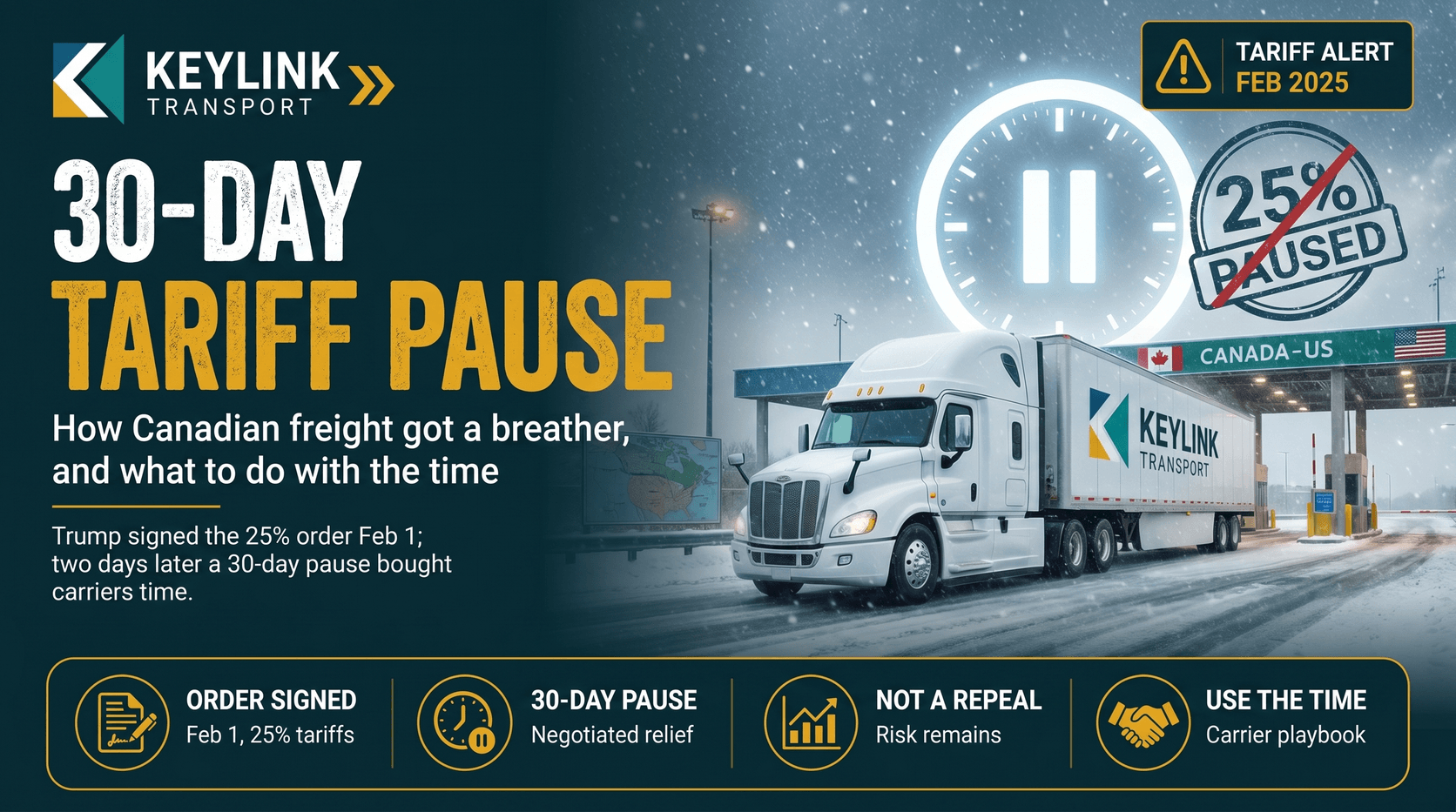
For 48 hours at the start of February, Canadian trucking was staring at the most dramatic policy shock in cross-border freight since the closure of the border at the start of the pandemic. On February 1, President Trump signed an executive order imposing a 25% tariff on most Canadian goods and a 10% tariff on Canadian energy, set to take effect February 4. Then, on February 3, after a phone call with Prime Minister Trudeau, the order was paused for 30 days.
The freight industry got a window. The question now is what to do with it.
February 1: The Order That Almost Was
On February 1, 2025, Trump signed an executive order under the International Emergency Economic Powers Act imposing a 25% tariff on Canadian and Mexican goods, and a 10% tariff on Canadian energy. The order was framed as a response to fentanyl and migration concerns, citing a national emergency at the northern border. Reuters reported the announcement triggered an immediate 1.5% drop in the Canadian dollar and a 600-point swing in the TSX.
For carriers, the practical question was how to handle freight already in transit. Loads that crossed the border before midnight on February 4 would clear at pre-tariff rates. Loads behind them would not. Dispatch teams across Canada spent February 2 and 3 calling drivers, expediting customs paperwork, and trying to get tariff-sensitive freight south of the line before the deadline.
The Pause: What Trudeau and Sheinbaum Actually Got
On February 3, Prime Minister Trudeau and President Trump held a 50-minute call. Hours later, Trudeau announced on social media that Canada had agreed to a $1.3 billion border plan involving new Black Hawk helicopters, additional CBSA personnel, and the appointment of a "fentanyl czar." In exchange, Trump agreed to pause the tariff order for 30 days.
Mexico got a similar deal earlier in the day. CBC's reporting confirmed the new deadline as March 4. Most observers noted that the substance of the deal was largely policy already in place under previous border agreements, repackaged for an audience of one.
Then, on February 10, Trump signed a separate proclamation reinstating 25% tariffs on all imported steel and aluminum, set to take effect March 12. The White House announcement ended exemptions and quota arrangements that Canadian steel producers had operated under since 2019. That tariff is currently scheduled to land regardless of the broader Canada-Mexico pause.
What This Pause Is, and What It Isn't
This pause is real, but it is narrow. Three things are worth understanding clearly.
It is a 30-day delay, not a deal. The tariff order has not been rescinded. It has been suspended until March 4. If the Trump administration is not satisfied with Canada's border progress in early March, the same 25% tariff could land with no further notice.
Steel and aluminum are separate. The March 12 steel and aluminum tariff is a Section 232 action, not part of the IEEPA fentanyl order. Canadian steel and aluminum producers are looking at a hard tariff date that has not been suspended.
The threat itself is now priced in. Even with the pause, freight markets, currency markets and shipper procurement teams are now operating under the assumption that tariffs are a live risk every 30 days. That changes the cost of capital, the willingness to commit to long-term contracts, and the spot rates carriers can command.
What Carriers Saw at the Border
The 48-hour scramble between February 1 and February 3 was the most concentrated freight movement most cross-border carriers have seen since the early-COVID toilet paper run. Border crossings at Windsor, Sarnia, Pacific Highway and Emerson all saw extended wait times. Brokers were processing customs entries in the early morning hours to clear freight before the deadline.
"What we saw on February 2 and 3 was every shipper with cross-border exposure asking the same question at the same time: 'Can you get this load south of the line by Tuesday?' That is not a freight market. That is a stampede." - Cross-border dispatch lead, Canadian regional carrier
Once the pause was announced on February 3 evening, the freight market did not relax. Spot rates on cross-border lanes remained elevated through the second week of February as shippers continued to front-load tariff-sensitive inventory ahead of March 4.
The 30-Day Window: A Carrier and Shipper Playbook
Whatever happens on March 4, the shape of the cross-border freight market in 2025 is now set. Tariffs are a live risk on a 30-day cycle. Steel and aluminum are landing on March 12 regardless. Currency volatility is built in. Here is how to use the window.
Move Tariff-Sensitive Inventory Now
If you have steel, aluminum, autos, lumber or agricultural inputs queued for cross-border movement in the next quarter, accelerate. The cost of a few extra days of inventory is small compared to absorbing a 25% tariff if the March 4 deadline isn't extended.
Price Volatility Into Quotes
Carriers should not be locking in long-term cross-border rates without explicit tariff escalator clauses. Shippers should expect to see those clauses and accept them if they want capacity.
Document CUSMA Origin Aggressively
Even under a tariff regime, USMCA-compliant goods may receive carve-outs. Get every certificate of origin in order now. Brokers should be reviewing classifications and origin documentation as a standing weekly task.
Watch the Steel and Aluminum Date
March 12 is the effective date for Section 232 steel and aluminum tariffs. That date is currently firm. Steel and aluminum shippers should treat this as a hard deadline regardless of what happens with the IEEPA tariff on March 4.
Pick Carriers That Communicate, Not Just Quote
Spot rates are not the only thing that matters when policy moves on a 48-hour cycle. The carrier who calls you on a Sunday afternoon to flag a tariff change is worth more than one who is ten cents cheaper per mile.
Keylink runs Canada-USA full truckload lanes for shippers who can't afford to be caught flat-footed by a tariff date. We document, we communicate, and we move.
Talk to Our Team →The Bottom Line
The 30-day pause is a window, not a peace. Trump's stated position has not changed. The Canadian government's leverage has not improved. The Liberal leadership race won't conclude until March 9, five days after the IEEPA deadline. A federal election almost certainly follows.
For Canadian carriers and shippers, the path forward is not about predicting whether tariffs will land on March 4. It is about being structurally ready for the version of the world where they do, while staying flexible if they don't. That means contract clauses, origin documentation, surcharge formulas, and carrier relationships you can rely on when the next 48-hour news cycle hits.
At Keylink, we are running cross-border freight the same way we always do: documented, communicated, and on time. The next deadline is March 4. We will be ready either way.