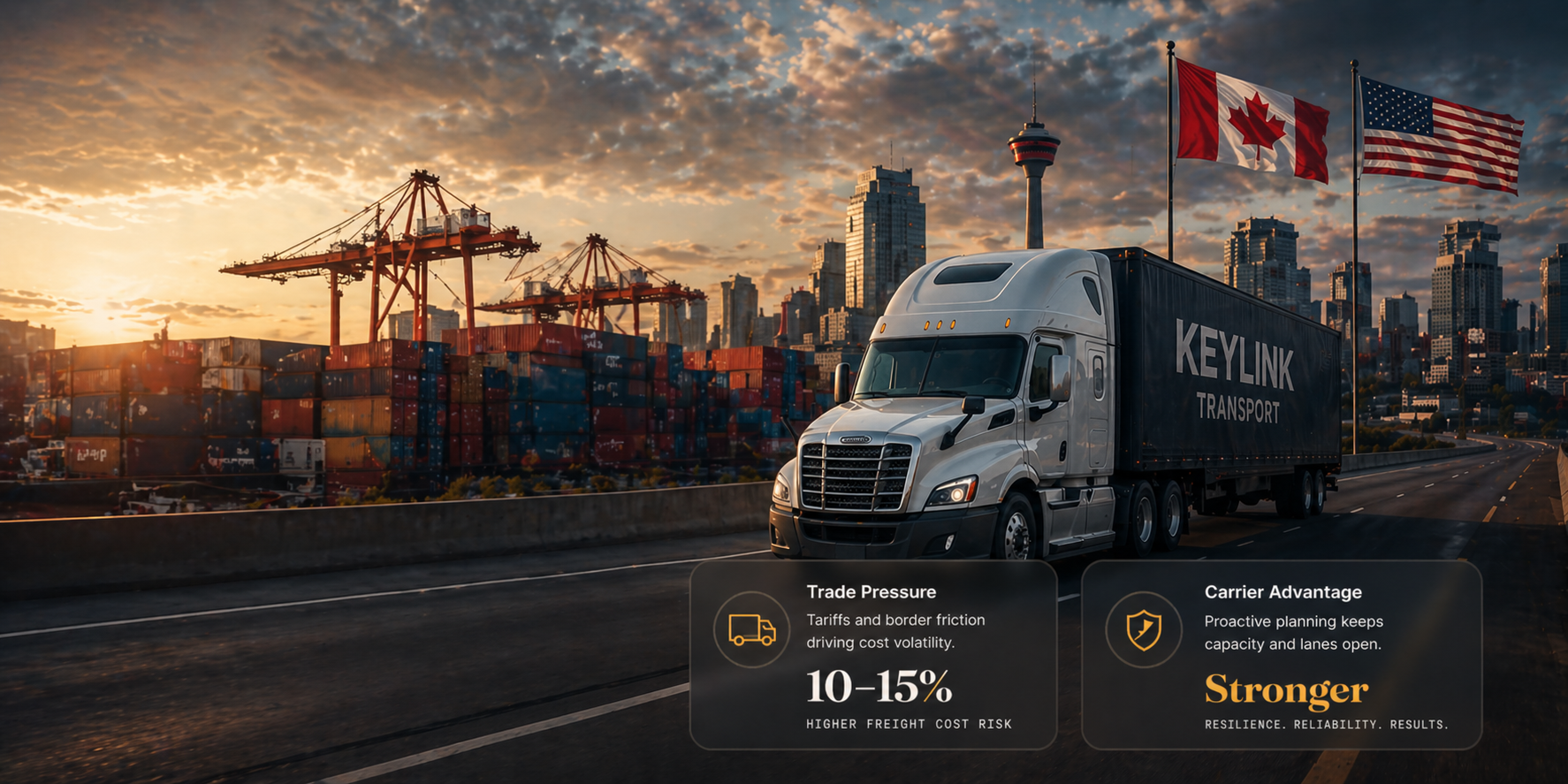
Two weeks into 2025 and the political map for Canadian trucking has been redrawn twice. Justin Trudeau announced his resignation as Liberal leader on January 6. Donald Trump was inaugurated as the 47th President of the United States on January 20. Between the two, Canada lost its negotiating counterpart and gained an American administration that has spent the past two months threatening 25% tariffs on every Canadian export.
For Canadian carriers and shippers, the next 90 days are about contingency, not strategy. Here is what we know, what is still uncertain, and what every cross-border operator should be doing right now.
Two Shocks in 14 Days
On January 6, 2025, Justin Trudeau announced he would step down as Liberal leader once a successor is chosen, ending nine years as prime minister. CBC's reporting noted that Trudeau also asked the Governor General to prorogue Parliament until March 24, freezing federal legislative business during what is shaping up to be the most consequential trade fight in a generation.
Two weeks later, on January 20, Donald Trump was sworn in. Reuters reported that Trump used his inaugural address to declare a "national emergency at our southern border" and signalled an aggressive tariff agenda. He stopped short of imposing the threatened 25% tariff on Canadian and Mexican goods on day one, but indicated a February 1 deadline.
Trudeau's Exit and the Liberal Vacuum
The Liberal leadership race is now underway. Mark Carney, former governor of the Bank of Canada and the Bank of England, and Chrystia Freeland, the former finance minister whose December resignation accelerated the political crisis, are the early front-runners. The new leader will be chosen on March 9, with a federal election likely shortly after.
For the trucking industry, the practical issue is that Canada is heading into a tariff confrontation without a stable negotiating partner. Trudeau remains prime minister but his political authority is gone. Whatever deal is struck before March is at risk of being walked back by whichever party forms the next government. Canadian provinces and business associations are increasingly bypassing Ottawa and lobbying Washington directly.
Trump's Day One: Tariffs Threatened, Not Imposed
The market had braced for an immediate tariff order. It did not come. Instead, Trump signed a presidential memorandum directing the Treasury, Commerce and USTR to study the trade deficit and recommend tariff actions by April 1. The America First Trade Policy memo directs a comprehensive review of the USMCA, fentanyl-related tariffs, and currency practices.
However, in remarks the same evening, Trump told reporters he intended to impose 25% tariffs on Canada and Mexico starting February 1. The Canadian Trucking Alliance, which represents the bulk of Canada's for-hire fleets, has warned members to assume tariffs are coming and to model the cost impact now.
"We are gathering intelligence to inform a comprehensive review of trading relationships. The President has been clear: this review will not take 100 days." - White House senior official, January 20, 2025
What This Means for Canadian Trucking
Cross-border freight from Canada to the US accounts for roughly 75% of all bilateral trade by truck volume. A 25% tariff would not stop trucks from rolling, but it would do three things almost immediately.
First, it would compress shipper margins to the point that some loads stop pencilling out. Carriers will see softer demand on the affected categories within two to four weeks. Second, it would force a renegotiation of every fixed-rate cross-border contract written in 2024, because the underlying landed cost just changed. Third, it would push freight onto faster, higher-priced expedited modes for tariff-sensitive inventory that needs to clear before the next round of duties.
The First-Quarter 2025 Playbook
Whether tariffs land on February 1, March 1, or April 2, the actions a carrier or shipper takes between now and the end of February will shape how well they handle whatever comes.
Audit Cross-Border Exposure
Pull every active cross-border lane and identify which are tariff-sensitive. Steel, aluminum, autos, lumber, agriculture and energy are the categories most often named. If you ship in those, model what a 10%, 15% and 25% tariff does to your landed cost.
Front-Load Inventory Where the Math Works
If your inputs are likely tariff-affected and warehousing capacity exists, accelerate Q1 receiving. The cost of three extra weeks of inventory is small compared to absorbing a sudden duty mid-quarter.
Re-Open Surcharge Conversations
Fixed fuel surcharge tables and fixed cross-border accessorials will not survive a tariff regime. Move to weekly index-linked formulas with carriers willing to absorb short-term volatility for medium-term partnership.
Verify CUSMA Origin Documentation
The Trump administration has signalled that USMCA-compliant goods may receive carve-outs. Make sure your origin certificates are in order and that brokers can produce them on demand. The carriers and shippers ready with paperwork will move first when carve-outs are issued.
Pick Your Carrier Conversations Now
The carriers with the strongest cross-border programs will be over-subscribed by mid-February. Lock in capacity with a partner you trust before the freight market discovers what tariffs do to spot rates.
Keylink runs Canada-USA full truckload lanes for shippers who can't afford to be surprised by a tariff at the border. Talk to us before the next round.
Talk to Our Team →The Bottom Line
The Trudeau-to-Trump transition has handed Canadian trucking the most uncertain start to a year since 2020. The good news is that nothing has actually happened yet at the border. The tariffs are still threatened, not imposed. The CUSMA framework is still in force. Trucks are still rolling.
The bad news is that uncertainty itself is a cost. Shippers slow capital decisions. Spot exposure rises. Carriers pull back on fleet expansion. Every week that goes by without clarity is a week of pent-up freight risk.
At Keylink, we are running our cross-border lanes the same way we always do: with full CUSMA documentation, weekly index-linked surcharges, and dispatch that picks up the phone when the news shifts. The trucks have to keep moving regardless of who is in office. Ours will.