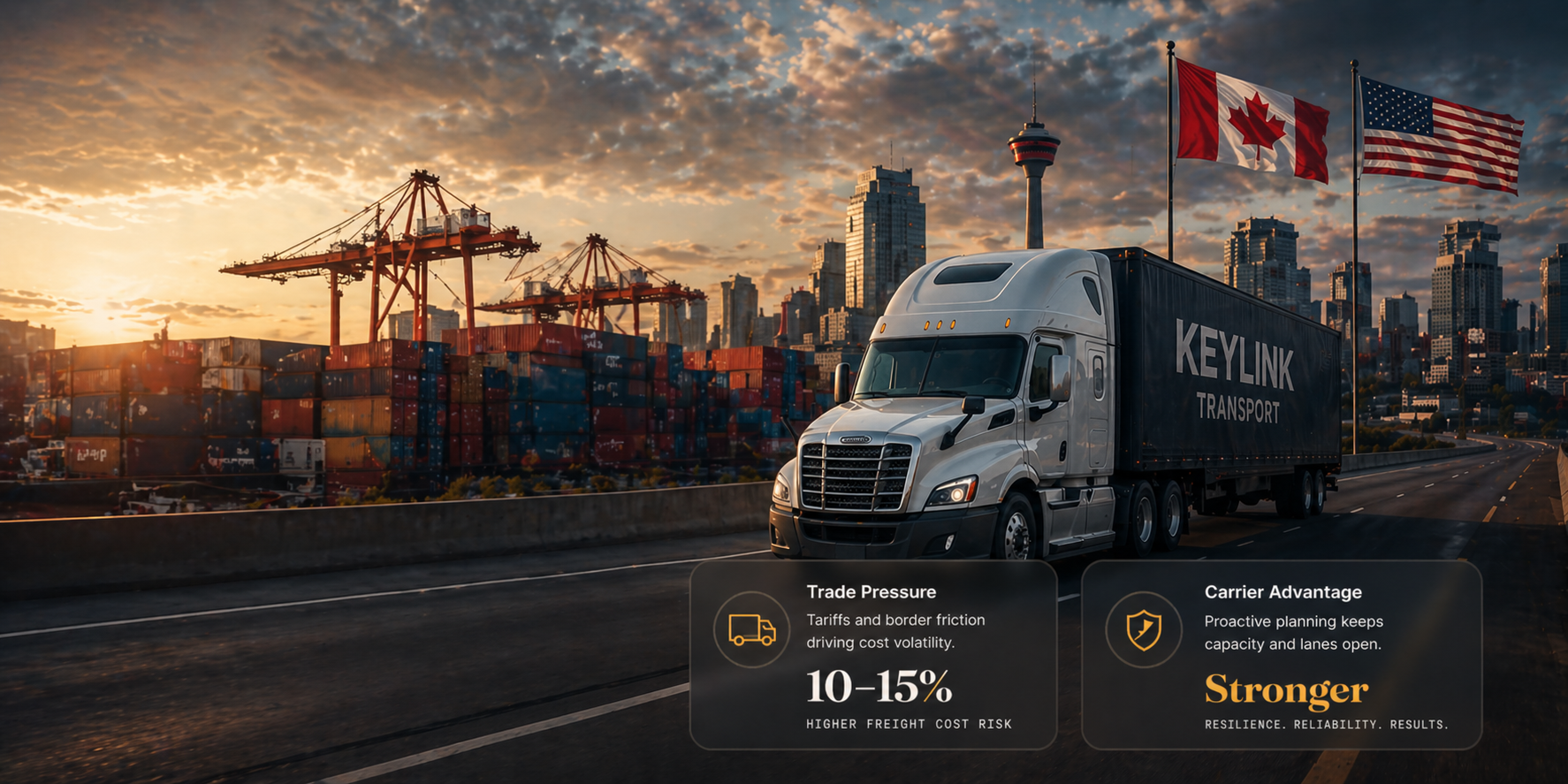
Donald Trump won the presidency on November 5, returning to office with Republican majorities in both chambers of Congress. AP News called the race in the early hours of November 6, with Trump securing 312 electoral votes against Vice President Kamala Harris's 226. The trifecta gives Trump unified government for at least the first two years of his term and a clearer runway to enact his economic platform than he had in 2017.
For Canadian carriers and shippers, the question is no longer whether Trump's tariff agenda is real. The question is what scenario lands, when, and how to plan freight networks against it. Here is the tariff math every Canadian operator should be running before January 20.
November 5: The Result
The result is conclusive. Trump won the popular vote, the electoral college, and improved Republican margins in critical Senate races. CBC's post-election coverage immediately framed the implications for Canada through the lens of trade and tariff policy. Within 24 hours, Prime Minister Trudeau had convened a cabinet committee on Canada-US relations.
The Trump transition team has begun signalling an aggressive opening posture on trade. Bloomberg's reporting on the transition identifies the appointment of trade hawks to USTR and Treasury as the leading indicator of which tariff promises will translate into policy.
The Stated Tariff Platform
Trump's tariff platform during the 2024 campaign included three core proposals.
A 10-20% universal tariff on all imported goods entering the US. This would apply to imports from every country, including Canada and Mexico, regardless of trade agreement status.
A 60% tariff on Chinese imports. Higher than the existing Section 301 framework, this would effectively decouple critical Chinese goods from the US market and accelerate near-shoring to Mexico and Canada.
Reciprocal tariffs mirroring duties applied by US trading partners on US exports. The Trump campaign framed this as restoring "fair trade" but in practice would mean elevated tariffs on countries with consumption taxes (VAT) that the campaign's economic team treats as effective tariffs.
Three Scenarios for Canadian Freight
The actual tariff regime that lands will fall somewhere on a spectrum from "campaign rhetoric softened in office" to "full platform implementation." Canadian shippers should model three scenarios.
"Even Scenario 1 reshapes how cross-border freight prices. Scenario 2 reshapes which lanes exist. Scenario 3 reshapes the structure of the Canadian economy. Plan for at least Scenario 2." - Toronto-based trade consultancy briefing, November 2024
Scenario 1: 10% universal, CUSMA-exempt. The most likely outcome by Q2 2025. A 10% tariff on non-CUSMA goods entering the US. Canadian freight largely insulated where it qualifies under USMCA rules of origin. The freight market sees a 5-8% volume contraction on tariff-affected lanes.
Scenario 2: 20% universal, partial Canada exemption. A larger tariff with country-specific carve-outs negotiated through the inauguration window. Tariff-affected categories see 15-25% volume contraction. Cross-border lane rates firm 10-15% as capacity exits the affected segments.
Scenario 3: Full platform, no exemptions. 20% universal plus 60% on China. Massive supply chain restructuring. Freight network reorganizes around Canadian and Mexican production hubs. Cross-border lane volumes contract 25-35% in the first year, then recover as near-shoring volume rebuilds.
What Changes Between Now and January 20
The 70-day transition window is short but consequential. Three things to watch.
Personnel signals. Treasury, Commerce, USTR and the National Economic Council appointments will telegraph the practical version of the tariff platform. Career trade lawyer appointments suggest moderation; political appointees signal aggression.
Lobbying outcomes. US automakers, retailers and agricultural exporters will lobby hard for carve-outs. Their success or failure between now and January 20 will shape the structure of any tariff order.
Canadian negotiating posture. The Trudeau government's pre-inauguration outreach will determine whether Canada is in the room when the order is drafted, or just on the receiving end.
A Pre-Inauguration Shipper Playbook
Run All Three Scenarios on Your Top 20 SKUs
For your 20 highest-volume cross-border products, model the landed cost impact of 10%, 20% and 25% tariffs. Identify which products are economic dead-ends under which scenarios.
Verify CUSMA Origin on Every Active SKU
The single most likely insulator from a Trump tariff is USMCA compliance. Audit your origin documentation now. Products with weak origin certification need to be reformulated or repositioned.
Front-Load January Inventory
Cross-border inventory that needs to land in January and February should be accelerated to clear before January 20. The pre-inauguration window is the safest freight window in the next 12 months.
Build Tariff Escalator Clauses Into 2025 Contracts
Any contract being negotiated for 2025 should have explicit tariff pass-through language. Carriers and shippers who lock fixed pricing without these clauses are setting up disputes.
Engage Federal and Provincial Trade Offices
The Trudeau government's outreach to Trump is more effective when industry associations and provincial governments lobby in parallel. Don't sit out the next 70 days.
Keylink runs Canada-USA full truckload lanes for shippers who need to clear inventory before the calendar turns. Talk to us before January.
Talk to Our Team →The Bottom Line
Trump's victory is the largest single change in the operating environment for Canadian cross-border freight in over thirty years. The tariff math is no longer hypothetical. The question is which version of the tariff lands and how Canadian shippers and carriers position before it does.
The 70 days between now and inauguration are the most important planning window of the year. Audit cross-border SKUs. Lock CUSMA documentation. Build escalator clauses. Engage with industry associations. The shippers who do this work in November and December will be ready when whatever lands, lands.
At Keylink, we are doing exactly this with our shippers. Our cross-border lanes will keep running. Our pricing will be transparent. Our communication with shippers will be ahead of any policy change, not behind it.