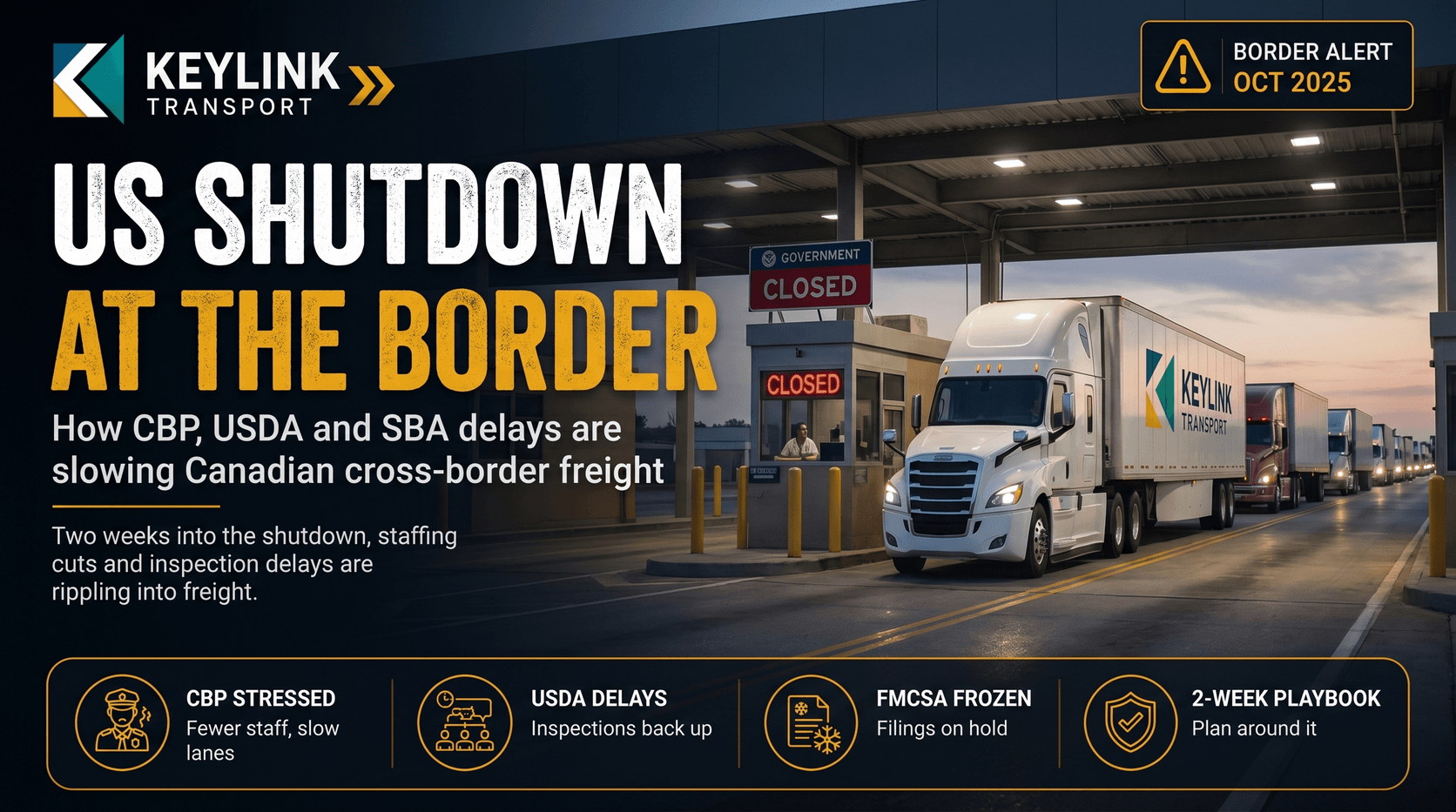
At 12:01 AM on October 1, the US federal government entered its first shutdown since 2019 after the Senate failed to pass a continuing resolution. Two weeks in, the cumulative effects on cross-border freight are real but uneven. Customs and Border Protection officers continue to work as essential employees but are unpaid. USDA and FDA inspection capacity has been reduced. SBA loan financing for small carriers has stopped. Federal trucking rule-making is on hold.
For Canadian carriers running into the US, here is what is actually different at the border, what isn't, and what to do about it.
How the Shutdown Started
The shutdown is the result of a Senate impasse over healthcare provisions in the FY2026 continuing resolution. Reuters reported that Senate Democrats blocked the CR after Republican leadership refused to extend Affordable Care Act premium subsidies that expire at year-end. With no path to 60 votes, the federal government's funding lapsed at midnight on October 1.
Approximately 750,000 federal employees were either furloughed or working without pay as of October 14. AP News reported that core border, transportation security, and law enforcement functions are continuing under "essential employee" designations, but with significant strain.
CBP at the Border: Working But Stressed
Customs and Border Protection officers at every Canada-US land port are still on duty. Cross-border trucks are still being processed. The bottleneck is staffing depth: ports that normally run at 100% staffing during peak hours are running closer to 75-85% as officers manage child care, second jobs and morale challenges.
The practical effect on Canadian cross-border carriers has been longer wait times at peak windows, particularly mid-morning at the Pacific Highway, Sweetgrass and Sarnia crossings. Off-peak transit has been largely unaffected. Carriers with FAST/CTPAT trusted-trader certifications continue to use dedicated lanes with normal flow.
USDA and FDA: The Hidden Friction
Behind CBP, federal agencies that conduct specialized cargo inspections have taken bigger hits. USDA's Animal and Plant Health Inspection Service (APHIS) is operating at roughly 60% capacity. FDA inspection capacity for food and pharmaceutical imports has been similarly reduced.
"CBP is working. It's the agencies behind CBP that are slowing things down. Anything that needs an APHIS inspection or an FDA hold is taking 50-100% longer than normal." - Cross-border customs broker, mid-October 2025
For Canadian carriers moving agricultural products, processed foods, or pharmaceuticals into the US, the cascade is real. The Canadian Trucking Alliance's October bulletin noted that loads requiring secondary inspection are seeing 6-18 hour delays, with some refrigerated loads at risk of cargo damage from extended border holds.
FMCSA Filings and Renewals
The Federal Motor Carrier Safety Administration is operating with reduced staff. New operating authority filings, USDOT registration renewals, and broker bond filings are all being processed but with longer turnaround times. Companies that submitted MC numbers in late September are still waiting for issuance.
For carriers planning to add capacity in Q4, the timeline assumption should be that any FMCSA action takes at least 30 days post-shutdown to clear backlog. New entrants should expect to delay first revenue runs accordingly.
The Cascade Into Shippers
Beyond the border, the shutdown is hitting freight indirectly through shipper liquidity. Small Business Administration loan approvals are paused. Federal contractor payments are delayed. Federally-financed agricultural support programs have stopped issuing checks. Shippers operating on tight cash conversion cycles are pulling back on freight orders, with the heaviest effect on agricultural and industrial shippers in the US Midwest and South.
A Two-Week Shutdown Playbook
Avoid Mid-Morning Border Windows
Wait times during the 9 AM to noon window have grown noticeably. Schedule cross-border departures for early morning or evening windows where CBP staffing strain is less severe.
Pre-Clear Inspection Holds Where Possible
For agricultural and food-grade loads, work with brokers to pre-file APHIS or FDA documentation. Loads that arrive with paperwork already lodged are processed first.
Build Refrigerated Cargo Buffer
Reefer loads at risk of inspection delays should be quoted with an additional 12-hour delivery buffer. Communicate this to receivers up front.
Confirm Shipper Payment Cycles
Federally-funded shippers may delay payment during the shutdown. Audit your AR concentration in agriculture, defense contracting and federal services. Pull credit limits where exposure is high.
Watch the Aviation Bottleneck
If TSA or FAA staffing strain produces flight cancellations, expedited air freight will divert to ground. That can absorb truckload capacity quickly. Be ready to flex pricing.
Keylink runs Canada-USA full truckload lanes with FAST/CTPAT processing and pre-cleared documentation. Shutdowns slow some carriers. Not us.
Talk to Our Team →The Bottom Line
The October shutdown is the third major cross-border friction event of 2025, after the IEEPA tariff in March and the Iran-driven diesel spike in June. Each one has reshaped what carriers and shippers consider operating reality. The shutdown will end, eventually. The lesson, again, is that trucking now operates at the intersection of three nervous systems: tariff policy, energy markets and federal funding cycles. Each one can move freight in 24 hours.
At Keylink, we are running our cross-border lanes through this one the same way we ran the last two: documented, scheduled away from peak windows, and communicated with our shippers ahead of any delay. The freight has to keep moving. Ours does.