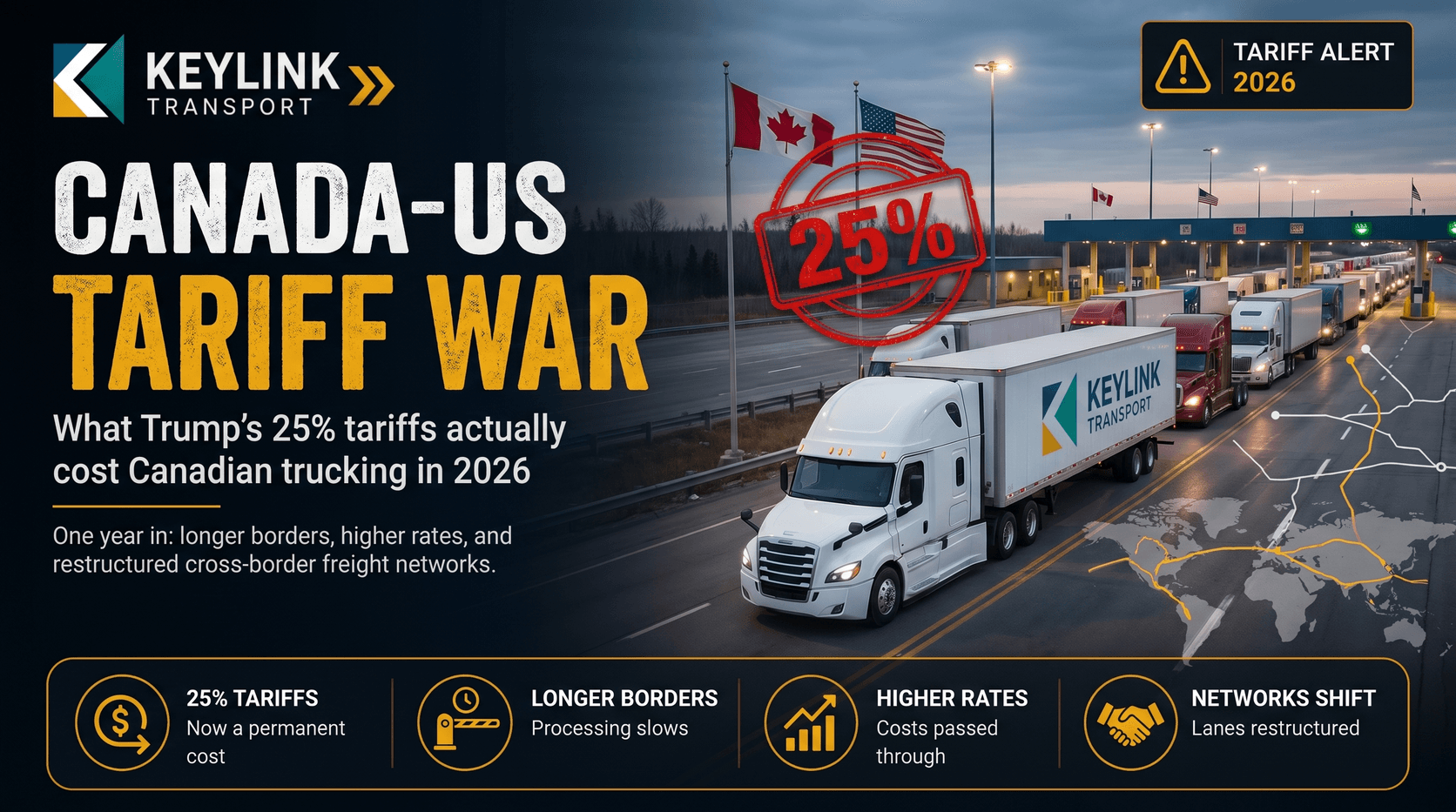
The Canada-US trade relationship that sustained decades of deeply integrated supply chains has been fundamentally altered. When the Trump administration imposed broad 25% tariffs on Canadian goods in early 2025, the impacts on freight were not theoretical: they showed up within weeks at the border. Extended inspection queues, new documentation requirements, rerouted commodity flows, and carriers restructuring their networks away from tariff-exposed cross-border lanes.
More than a year into this trade environment, the full cost picture has come into focus. For Canadian carriers operating cross-border lanes and for the shippers who depend on them, understanding the mechanics of these costs is no longer optional. It determines how you price loads, how you structure carrier relationships, and whether your freight moves on schedule or sits at the border.
This article breaks down the tariff timeline, the specific costs it has created for Canadian cross-border trucking, the sectors absorbing the most impact, and what you can do today to reduce exposure.
The Tariff Timeline: How We Got Here
February to March 2025: The Initial Announcements
The Trump administration announced broad tariff measures targeting Canadian goods in February 2025, citing fentanyl flows and border security concerns. The measures included a 25% duty on most Canadian goods and an additional 10% on energy products. Canada's federal government, under then-Prime Minister Justin Trudeau, responded with retaliatory surtaxes on approximately CAD $30 billion in US goods, targeting consumer products, steel, and aluminum from US producers.
The Canadian Trucking Alliance (CTA) immediately flagged the operational burden on carriers, noting that new documentation requirements for tariff-classified goods would substantially extend dwell times at land border crossings.
April to June 2025: CUSMA Complexity
The Canada-United States-Mexico Agreement (CUSMA, known in the US as USMCA) provides tariff exemptions for goods that meet rules-of-origin requirements. However, the Trump administration's tariff regime created a layered compliance environment: CUSMA-compliant goods were theoretically exempt, but proving origin compliance required enhanced documentation. Canada Border Services Agency (CBSA) and US Customs and Border Protection (CBP) both issued revised guidance on origin documentation requirements, creating a compliance learning curve across thousands of importers and exporters.
Late 2025 to Present: Settled but Elevated
By late 2025, the tariff regime had largely stabilized at elevated levels for non-CUSMA goods. Statistics Canada data showed a measurable contraction in bilateral merchandise trade volumes for tariff-affected commodity categories, with cross-border freight volumes on specific lanes declining 10 to 18% compared to pre-tariff baselines. The trade environment as of April 2026 remains one of managed uncertainty: CUSMA exemptions provide protection for compliant goods, but the non-CUSMA tariff framework creates ongoing cost exposure for sectors that cannot fully qualify for origin exemptions.
The Real Numbers Behind Cross-Border Freight Costs
The visible cost of tariffs, the duty assessed on the goods themselves, is what most supply chain conversations focus on. But for carriers and shippers operating cross-border lanes, the secondary cost is often larger and harder to forecast.
Direct Tariff Cost per Load
For a typical cross-border FTL load of softwood lumber valued at $40,000, a 25% US tariff adds $10,000 in duty cost at the border. That cost falls on the importer, but it reshapes freight economics: it changes commodity profitability, alters trade volumes on affected lanes, and in some cases makes the cross-border movement commercially unviable, eliminating the freight opportunity entirely.
Dwell Time and Carrier Economics
The less-discussed cost is time. At major Pacific Northwest border crossings, average wait times for commercial vehicles on inspected loads rose significantly following the tariff announcement. CBP commercial operations data showed extended processing windows as officers managed new documentation verification requirements for tariff-classified goods.
For a carrier, time at the border is real money. A truck sitting at the border for an additional 90 minutes represents approximately $90 to $125 in driver time at current Canadian wage levels, plus the opportunity cost of delayed delivery and the operational ripple effect on the driver's HOS (Hours of Service) cycle. Multiply that across a fleet running cross-border daily and you have a material cost increase that does not appear on any tariff schedule.
The Spot Rate Effect
As cross-border volumes contracted on tariff-hit commodity lanes, carriers with dedicated cross-border capacity found themselves with excess equipment on historically busy routes. This created downward spot rate pressure in Q2 2025, which sounds beneficial for shippers but creates a carrier health problem: rates that don't cover operating costs lead to capacity withdrawal, and when volumes recover, shippers face a smaller qualified carrier pool and elevated contract rates. The CTA's freight market tracking documented this pattern in real time across western Canada corridors.
"The full cost of tariff-driven disruption to cross-border freight is rarely just the duty. It is the dwell time, the rerouted volumes, the compliance burden, and the carrier capacity that quietly exits the lane."
Which Sectors Are Hit Hardest
Softwood Lumber: Compound Tariff Pressure
BC's softwood lumber sector was already subject to US countervailing and anti-dumping duties averaging 14 to 20% before the 2025 tariff round. Adding a 25% general tariff on top of existing duties created a combined duty burden exceeding 35 to 45% for many producers. Natural Resources Canada tracks the softwood lumber trade as a bellwether for Canada-US trade health. The compounded tariff burden caused measurable mill production cuts in BC's Interior and a corresponding reduction in FTL freight volumes on BC-to-Washington State lumber lanes.
Aluminum and Steel
Canadian aluminum producers, concentrated in Quebec but shipping product through multiple corridors, faced Section 232 national security tariffs layered under the 2025 measures. For carriers on lanes serving aluminum smelter outbound freight, reduced production volumes meant fewer loads and tighter lane economics.
Agricultural Products: Canola, Beef, and Pork
Canada's agricultural exports to the US represent billions in bilateral trade annually. Canola, beef, and pork are among the highest-volume commodities moving southbound on Canadian cross-border freight lanes. Tariff exposure on agricultural goods created immediate cost pressure for exporters and contributed to rerouting discussions around Pacific Rim export markets as an alternative to US-bound shipments. For carriers on BC and Alberta agricultural freight lanes, this translated into demand volatility that made capacity planning significantly more difficult.

The Border Processing Bottleneck
The administrative machinery of tariff compliance created its own friction layer at the Canada-US border. Understanding why crossings got slower helps carriers and shippers plan accordingly.
Documentation Complexity
Proving CUSMA eligibility under the Trump administration's tariff framework required more detailed origin documentation than the standard commercial invoice. For many shippers, this meant engaging customs brokers to produce certificates of origin, bill of materials analysis, and tariff classification confirmation for each commodity class. Shippers who had not previously needed customs brokerage support on CUSMA-standard loads suddenly required it. The CBSA export documentation portal saw a significant increase in filing volumes and processing queries.
ACE Filing Requirements
On the US side, CBP's Automated Commercial Environment (ACE) system requires importers and their brokers to file entry documentation in advance of cargo arrival. Under the new tariff framework, ACE filing requirements for tariff-affected goods categories became more stringent, and secondary inspection rates at commercial crossings increased. CBP's ACE portal provides current guidance for importers navigating the updated requirements.
FAST Lane Advantage
Carriers and importers enrolled in the Free and Secure Trade (FAST) program, which provides pre-approved commercial clearance for trusted partners, generally fared significantly better through the tariff disruption period. FAST-enrolled truck crossings at Pacific Highway and Peace Arch experienced materially shorter wait times than non-FAST commercial lanes. For carriers not yet enrolled in CBSA's Partners in Protection (PIP) program, which is the Canadian prerequisite for FAST, enrollment should be treated as a priority.
How Canadian Carriers Are Restructuring Their Networks
The freight market response to tariff-driven disruption has been pragmatic. Carriers are not passively absorbing costs. They are actively restructuring to reduce exposure and find new demand.
Shifting Capacity to Domestic BC-Alberta Lanes
Carriers with flexible capacity have rebalanced their networks toward domestic BC-Alberta and inter-provincial corridors where tariff exposure is zero. The BC-Alberta freight corridor, connecting Metro Vancouver with Calgary and Edmonton distribution centres, has seen increased carrier competition as cross-border capacity rotates inward. For shippers on domestic lanes, this has modestly improved capacity availability in some areas.
Building Border Buffer Time into Transit Schedules
Carriers who still operate cross-border lanes have standardized an additional 90 to 120 minutes of scheduled border dwell time into their transit estimates. This is no longer a buffer: it is the new baseline. Shippers who build delivery windows around pre-tariff border processing speeds will regularly miss commitments. Aligning delivery window expectations with current border realities is essential.
Dwell and Fuel Surcharge Pass-Through
The additional costs created by extended border dwell time do not disappear: they are being passed through to shippers via dwell time surcharges and revised fuel surcharge structures. Carriers who had not previously included border dwell provisions in their rate agreements have updated their standard contract language. Shippers reviewing carrier agreements should confirm how border dwell time is defined and charged.
Accelerating FAST and C-TPAT Enrollment
Forward-thinking cross-border carriers have prioritized enrollment in FAST and the US Customs-Trade Partnership Against Terrorism (C-TPAT) programs. These designations provide access to expedited commercial lanes and signal compliance credibility to CBP officers, reducing the likelihood of secondary inspection on routine loads. The C-TPAT program is open to US importers whose Canadian carrier partners are PIP-enrolled.
Partnering with Customs Brokers Proactively
The carriers managing cross-border disruption best are those with established customs broker relationships built before the tariff regime, not after the fact. Brokers who know a carrier's commodity mix can pre-classify goods, flag CUSMA eligibility issues before they become border holds, and manage ACE filing in ways that reduce CBP inspection trigger rates. Proactive compliance is measurably cheaper than reactive compliance.
What Shippers Need to Do Right Now
The tariff environment is not going to normalize in the near term. Here is what shippers moving goods across the Canada-US border should be doing today to protect their supply chains and freight budgets.
- Audit your CUSMA eligibility: Work with your customs broker to confirm which of your cross-border commodity lines meet CUSMA rules-of-origin requirements. Goods that qualify are tariff-exempt, and many shippers are paying tariffs on goods that qualify for exemption simply because the required documentation was never assembled. Global Affairs Canada's CUSMA resource centre provides current origin documentation guidance.
- Build border time into delivery commitments: Every customer-facing delivery window for cross-border shipments should account for a minimum of 2 to 3 hours at the border. Promises made on pre-tariff transit times will cause relationship damage when they are consistently missed.
- Review carrier contract language: Confirm that your carrier agreements include clear provisions for dwell time surcharges, how they are calculated, and at what threshold they apply. Ambiguous contract language around border delays creates invoice disputes that are corrosive to carrier relationships.
- Prioritize FAST-enrolled carriers: For high-volume cross-border shippers, working exclusively with FAST-enrolled carriers meaningfully reduces border dwell risk. Ask your carrier for their FAST enrollment status as a basic qualification criterion.
- Consider nearshoring for US-bound production: For shippers manufacturing goods in Canada that are heavily US-market-oriented and do not qualify for CUSMA exemption, the tariff environment is making a compelling case for reviewing production and distribution network structures. This is a medium-term strategic conversation, but the tariff regime has accelerated the timeline significantly.
- Maintain safety stock for tariff-sensitive categories: Goods subject to tariff-related border volatility should carry elevated safety stock at US-side distribution points to reduce the operational consequence of a delayed shipment. The carrying cost of additional inventory is almost always less than the cost of a missed delivery.
How Keylink Transport Navigates Tariff Uncertainty
At Keylink Transport, our cross-border operations are built around the compliance infrastructure that tariff disruption demands. We have operated FMCSA-authority cross-border lanes since our founding, and the regulatory discipline that requires has always been foundational to how we run our fleet.
- Established CBSA and CBP compliance protocols: Our operations team maintains current knowledge of documentation requirements for all commodity classes we transport. We do not learn compliance requirements at the border: we know them before the load moves.
- FAST program participation: Our cross-border operations incorporate FAST-eligible crossing procedures where available, reducing dwell time exposure on qualifying loads.
- Transparent border time communication: We build realistic border windows into every cross-border transit estimate. You will not receive delivery commitments based on pre-2025 crossing speeds.
- Customs broker network: We work with established customs brokers on both sides of the border who can pre-clear documentation and flag issues before they become border holds.
- Active cross-border authority: USDOT 2832041 | MC# 946449. Fully compliant on both sides. You can verify our safety and operating status on the FMCSA SMS portal.
If you are reviewing your cross-border carrier relationships in light of the tariff environment, we welcome that conversation. Explore our cross-border freight services or reach out directly through our contact page. We also recommend reading our related piece on navigating supply chain disruptions as a Canadian shipper, which covers the broader strategic context.
Keylink Transport operates compliant cross-border FTL capacity on western Canada lanes. We know the tariff landscape and we know the border. No surprises.
Get a Quote from Keylink →The Bottom Line
The Canada-US tariff regime that began in 2025 has permanently altered the economics of cross-border freight. The duty costs are real, but the secondary effects, extended border processing, new documentation requirements, reduced lane volumes, and carrier network restructuring, are where most of the operational cost lives.
Canadian shippers and carriers who have adapted their processes, built compliance infrastructure, and restructured their freight relationships to reflect the new operating environment are managing reasonably well. Those operating on 2024 assumptions are absorbing costs and delays that were entirely foreseeable.
The path forward is compliance discipline, realistic expectations, and carrier relationships built on transparency. The tariff environment is unlikely to normalize quickly. Build accordingly.