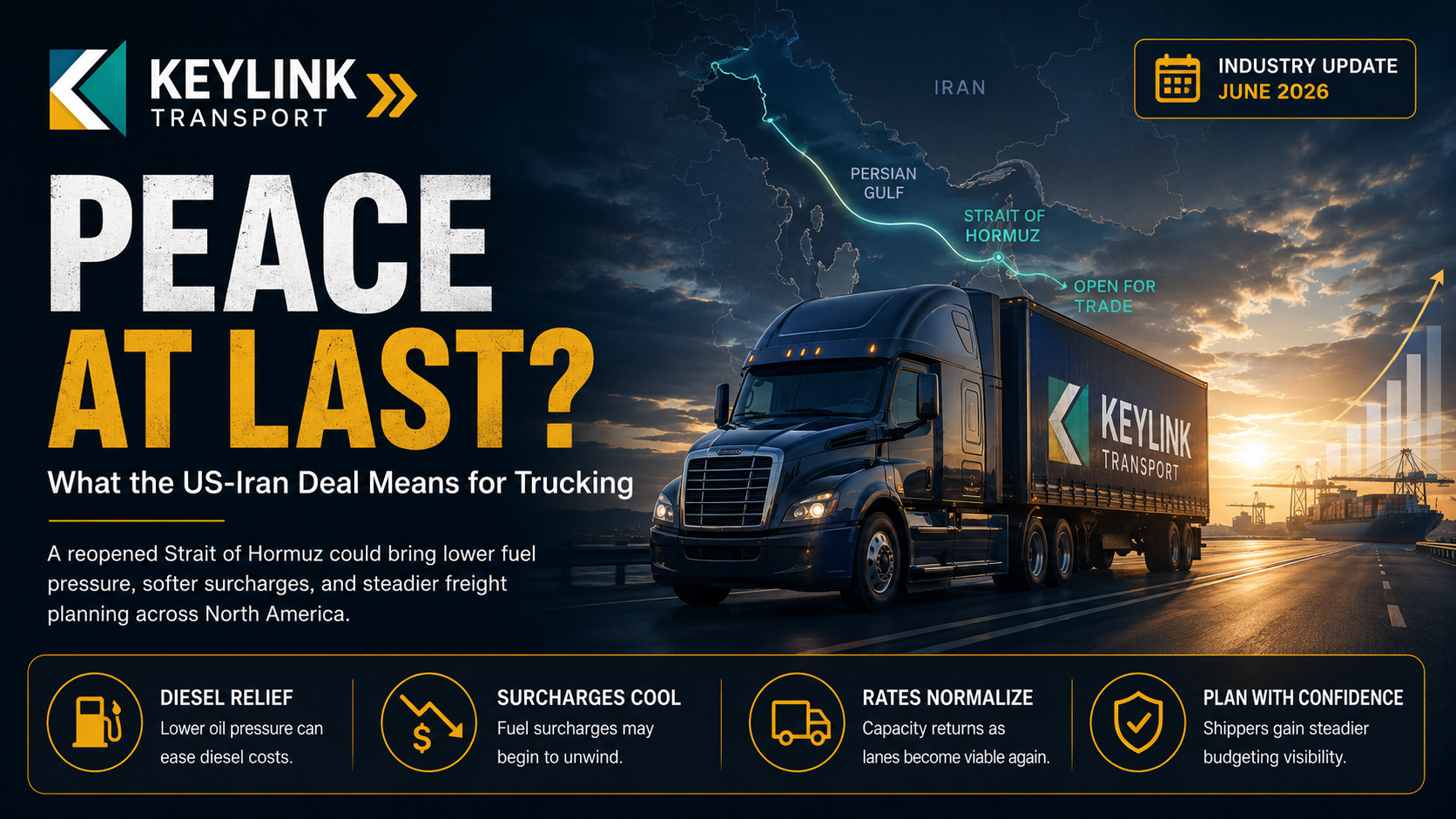
After the most expensive year for diesel that most carriers can remember, there is finally good news on the horizon. The United States and Iran have reached an agreement to end the conflict and reopen the Strait of Hormuz, the chokepoint whose closure drove the entire 2026 oil shock. The deal was announced through Pakistani Prime Minister Shehbaz Sharif, with both sides declaring the immediate and permanent termination of military operations on all fronts, including in Lebanon, and President Trump confirming that oil would flow once the Strait reopened on signing.
For an industry that has spent 2026 watching diesel break record after record, this is the headline everyone has been waiting for. But a signed memorandum and a litre of cheaper diesel are not the same thing, and the gap between them is where carriers and shippers need to pay attention. Here is what was actually agreed, what the oil market has already done about it, and what a genuine peace could mean for trucking rates over the rest of the year.
What Was Just Agreed
The framework, reported as a 60-day memorandum of understanding that the two sides had mostly agreed in late May, came together this week. The core terms, as reported by CNN and ABC News, center on four points: a permanent ceasefire across all fronts, the removal of the naval blockade and reopening of the Strait of Hormuz, steps to dismantle Iran's nuclear program, and economic incentives for Tehran if it complies. French President Emmanuel Macron called for a swift and full implementation of the memorandum.
This is the resolution to a story we have been tracking all year, from the Pakistan-brokered peace talks in April through the May oil shock and the brief June 8 flare-up that whipsawed diesel. The conflict reignited in February when the United States and Israel struck Iran over its nuclear program, and the Strait of Hormuz effectively closed to commercial traffic on February 28. Everything that happened to fuel prices after that traces back to that closure, which is why this deal matters so much.
"The single most important line in the agreement for a trucking company is not about missiles or centrifuges. It is the one that reopens the Strait of Hormuz."
The Oil Market Has Already Moved
Markets do not wait for ink to dry. As soon as a lasting ceasefire came into view, oil sold off hard. Global crude fell roughly 20% from its 2026 peak, and Brent posted a fall of about 19% in May alone, its worst month since the COVID crash of March 2020, with U.S. West Texas Intermediate down nearly 17% over the same stretch. By early June, Brent was trading near the high $80s, a world away from the $100-plus it hit in March when the Strait was shut. The chart below traces that round trip.
The cause-and-effect here is unusually clean. Hormuz closes, the supply of crude that reaches global markets is threatened, and traders price in a fear premium that can run $20 or $30 a barrel. Hormuz reopens under a credible deal, that premium evaporates. We are watching the second half of that cycle happen in real time.
Why the Strait of Hormuz Matters to a Truck in BC
It is fair to ask why a narrow waterway between Iran and Oman should set the price of diesel at a cardlock in Abbotsford. The answer is that oil is a global commodity. Roughly a fifth of the world's seaborne oil moves through Hormuz, and when that flow is choked, the price of every barrel everywhere rises to compete for the supply that remains. Canada produces plenty of its own crude, but Canadian diesel still trades against a world price, so a Gulf chokepoint lands at a Fraser Valley pump within weeks. We walked through that mechanism in detail in our piece on the Strait of Hormuz shipping crisis.
That is why the reopening is the line that matters most to carriers. The nuclear and security terms are what make the deal hold. The Hormuz clause is what brings diesel down.
What Peace Could Mean for Trucking
If the ceasefire holds and the Strait stays open, the back half of 2026 should look very different from the front half. Here is what a durable peace would realistically deliver for the freight market.
The Catch: Prices Fall Slower Than They Rise
Here is the part that does not make the headlines. Diesel goes up like a rocket and comes down like a feather. Pump prices respond almost instantly when crude spikes, but retailers and the supply chain are far slower to pass through the savings on the way down. Shippers who expect their fuel costs to halve the moment the deal is signed will be disappointed; the relief is real but it arrives in weeks and months, not days.
There is a second caution. This is the same conflict that produced a ceasefire in 2025 that then collapsed into renewed strikes in February 2026, and a brief but real missile exchange as recently as June 8. A 60-day memorandum is a strong signal, not a permanent settlement. The smart move is not to tear up your fuel strategy on the assumption that volatility is gone for good. It is to position for relief while staying protected if the deal wobbles.
"Diesel goes up like a rocket and comes down like a feather. The savings from this deal are real, but do not expect them all at once."
What Shippers Should Do Right Now
A turning market is exactly when good freight decisions get made. Three practical moves while the picture is improving but still uncertain:
How Keylink Is Handling the Turn
Keylink is a BC-based, asset-based full truckload carrier, and the way we priced freight on the way up is exactly how we price it on the way down. Our fuel surcharge tracks a published diesel benchmark and updates on a set cadence, which means as crude falls, our customers see the relief without having to ask for it. There is no flat fuel figure quietly padding the rate after the market has calmed.
Running our own trucks on direct contracts also means there is no chain of brokers each holding onto a slice of the savings before it reaches the customer. As capacity loosens and diesel eases, we would rather lock in long-term lane partnerships at fair rates than squeeze a short-term margin out of a soft market. That is the same approach we took when fuel was punishing, described in our piece on how the oil whiplash was squeezing small carriers, and it does not change just because the news got better.
A peace deal is genuinely good news for everyone who moves freight. The carriers and shippers who come out ahead will be the ones who capture the relief deliberately, with transparent pricing and stable relationships, rather than waiting for the savings to somehow appear on an invoice. If you want to make sure your freight budget actually benefits from the turn, that is a conversation worth having now.
Keylink runs a transparent, index-tied fuel surcharge, so when diesel falls, you see it. Lock in fair lane rates while the market is soft.
Get a Quote →Sources and Further Reading
- CNN, "US and Iran reach agreement that includes opening Strait of Hormuz", June 14, 2026.
- ABC News, "Iran live updates: Trump says US and Iran have reached a deal, opening the Strait of Hormuz", June 2026.
- CNBC, "Oil drops 20% from 2026 peak on optimism over U.S.-Iran ceasefire talks", May 29, 2026.
- CNBC, "Brent oil price posts biggest monthly loss in six years as market counts on a U.S.-Iran deal", May 29, 2026.
- AJOT / ITS Logistics, "Hormuz disruption drives freight market volatility into Q2", 2026.
- U.S. Energy Information Administration, "The Strait of Hormuz is the world's most important oil transit chokepoint."
- Britannica, "2026 Iran war: Deal, Strait of Hormuz, and conflict overview."
- Natural Resources Canada, Canadian diesel price tracker.